

Sarah Khurshid Khan’s
Flowers Coming Out of Their Mouths
September 4 - September 27, 2026
Opening Reception: September 4, 5-9pm
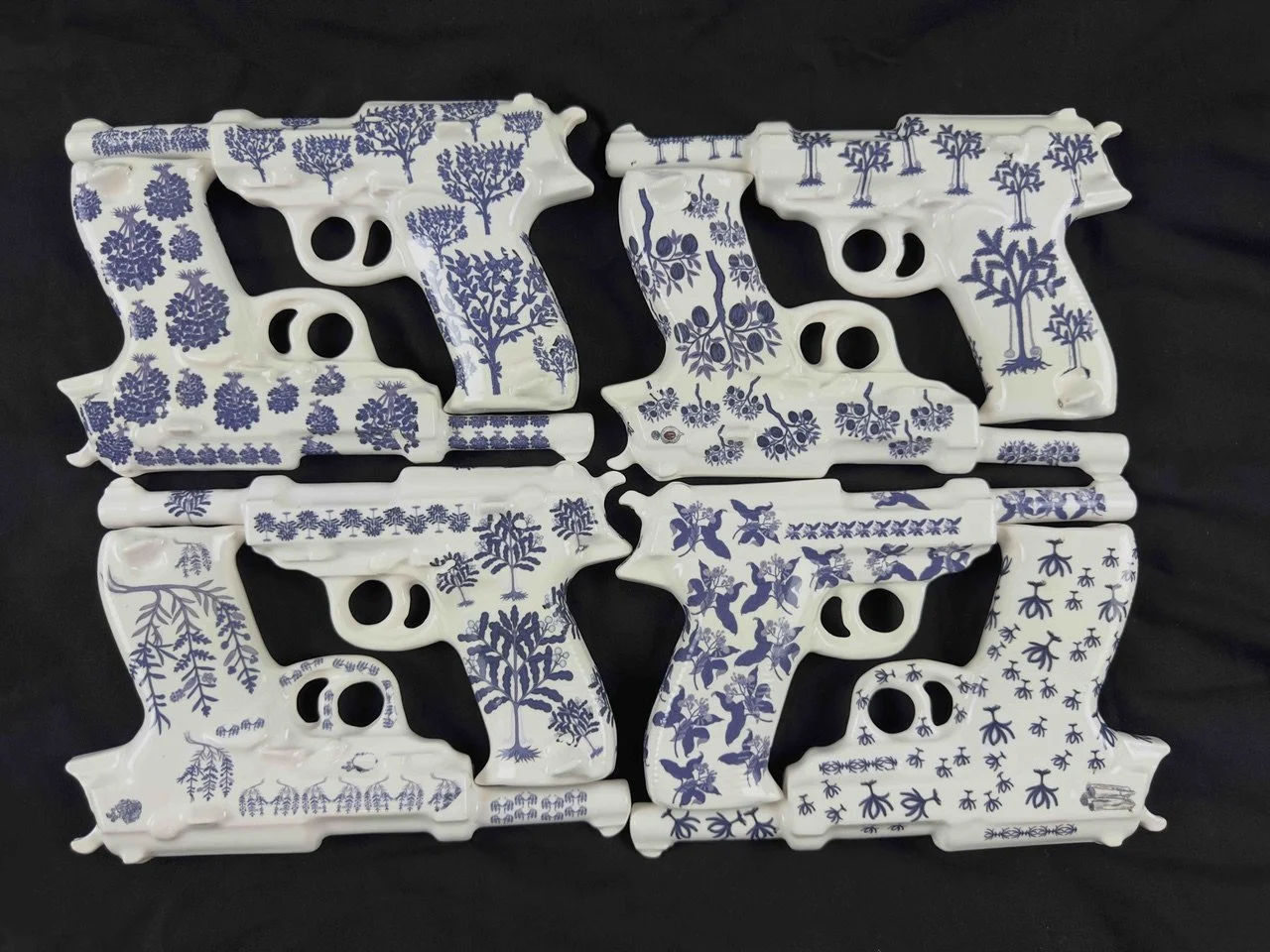
Weapons of Mass Creation/Destruction, Defend or Destroy? 8 blue and white porcelain Lugers covered in spices.
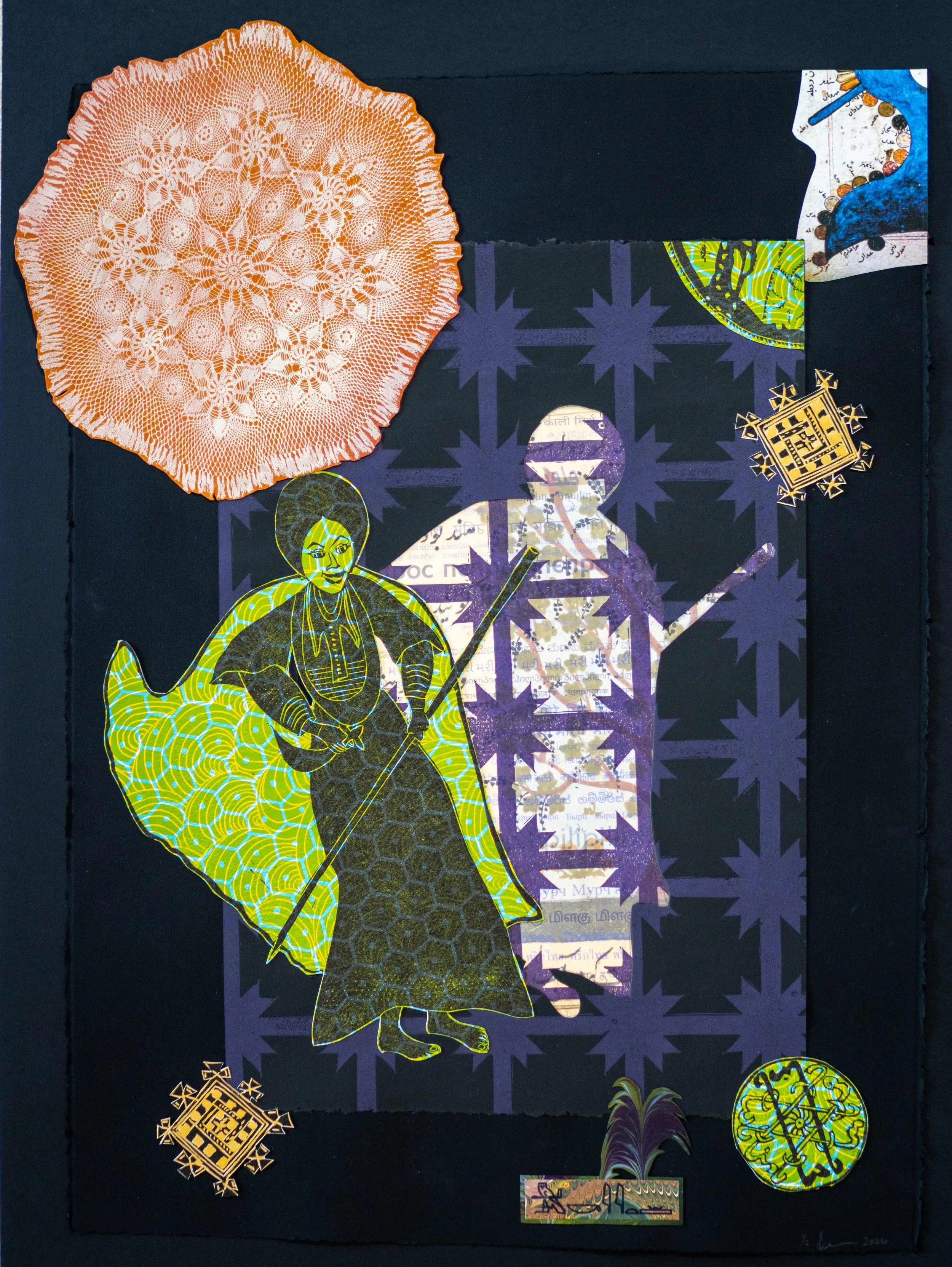
Bilqis, Defender, 22x 30 inches, Material: Lino cuts on letter press and French press prints on wasli paper and/or Rives Black and White papers, and hand marbled papers.
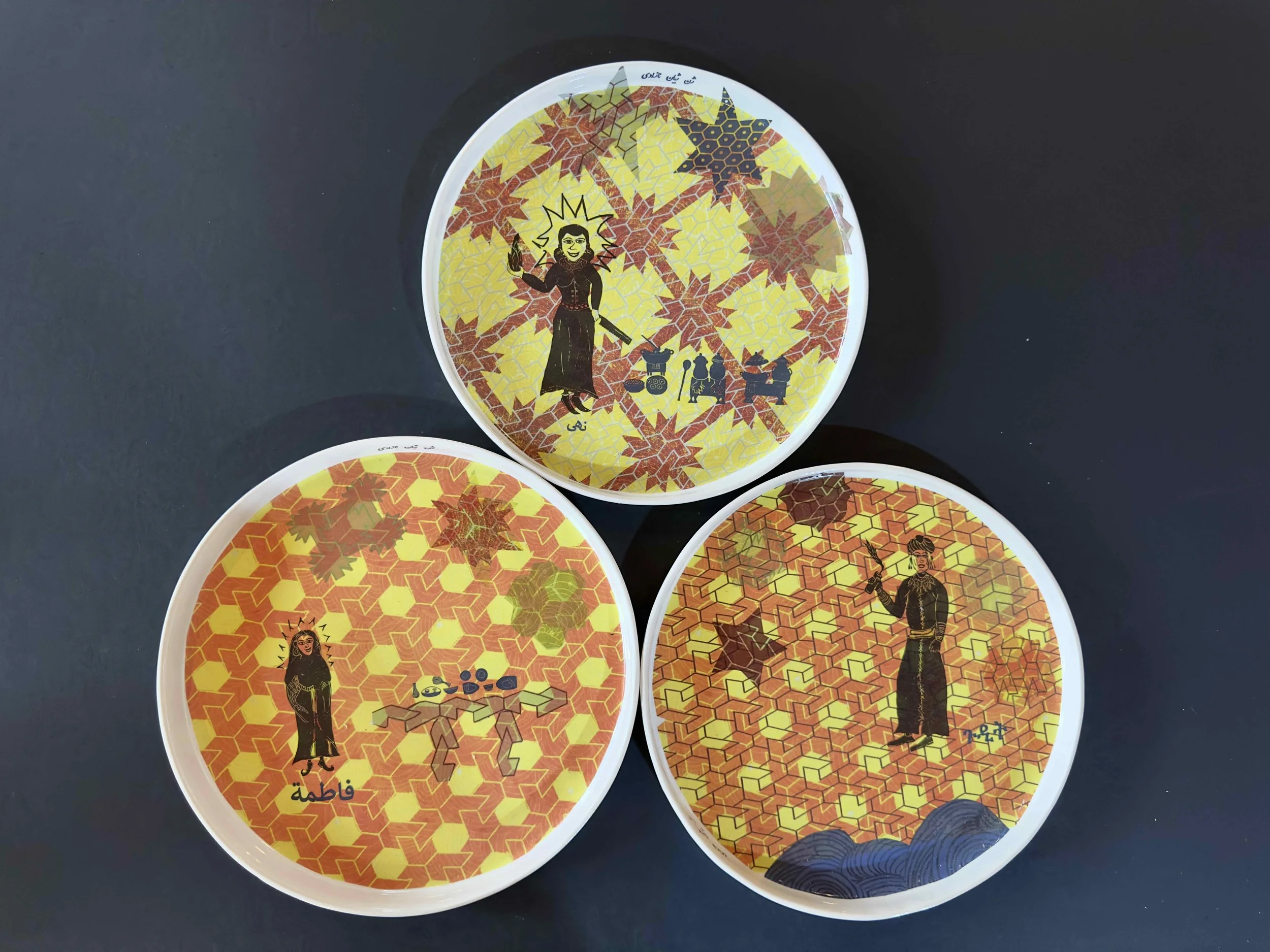
Enlighteners, Serve or Service?, 10 1/2"dia. porcelain plates.
Sarah Khurshid Khan rages into beauty, with the occasional gaali (swear), as if flowers floated out of her mouth. In her new solo show entitled “Flowers Coming Out of Their Mouths,” Khan presents 21 new collaged works, in her on-going exploration of a 16th C Persian Cook/Book of Life from Central India. Khan re-imagines feminist African, Arab, Asian pasts while reframing our understanding of people and plants, their names, and their migrations by mining imperial archives—British Library, New York Public Library, Metropolitan Museum of Art, and the New York Botanical Garden. Playfully serious and seriously playful, Khan poignantly reclaims the right to narrate and name her manifold histories, ancestral and acquired.
Her collages are laced with stylized plants and flowers inspired by indigenous African, Arab, and Asian ocean world peoples. Flora includes acacia trees, barley, black pepper, cinnamon, dates, frankincense, myrrh, orange blossom and rose. Peppered with ancient and Islamic geometries, her scenarios include diverse ancient maps, world languages, archival imagery from across regional ocean worlds, and hand-marbled papers. Among the pantheon of femmes and sheroes, porcelain weapons of mass creation/destruction adorn the gallery and complement her collages—as spice scents waft.
Bake or Bludgeon
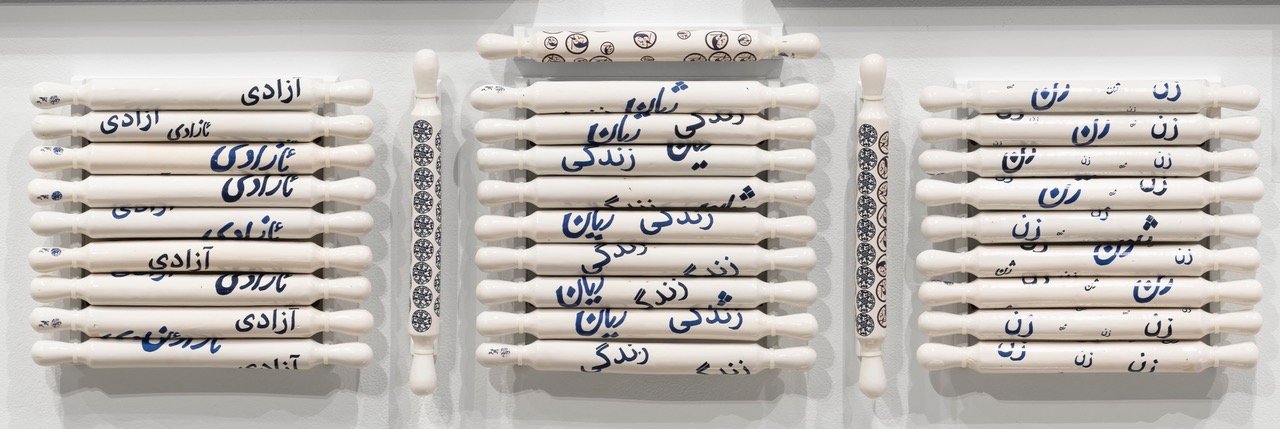
Women, Life, Freedom in Persian & Kurdish
on 12 porcelain rolling pins with blue and white script
2025
Weapons of Mass Creation or Destruction
The Book of Delights (1469–1500 CE), sparked my recent bodies of works—prints, porcelains, and films. The cookbook, written in Persian and illustrated in the Sultanate miniature painting tradition, depicts African, Arab, Turkic and Central Asian women dutifully serving and surrounding the Sultan Ghiyath Shah of Malwa. He commissioned the cookbook in Shadiabad, his retirement City of Joy. Largely intact, the miniatures include detailed cookware, flora, and pastel-vibrant illustrations. Polyethnic attendants, frozen in half or three-quarter profiles, prepare spice-laden foods, medicinals, attars and aphrodisiacs with skill. At the Sultan’s request, the women hunt, fish, and engage in animated culinary, philosophical and religious debates.
The illustrated cookbook demands a recasting. Few notice the attendants who harvest, hunt, cook and debate. The original images portray cosmopolitan femmes/women who serve, and most likely service the Shah. We know little about these women’s lives. From where, in that vast Central Indian and African Indian Ocean World, did they come? What were their nuanced narratives? Did they consider the work a delight? I ask, if the polyethnic world of the zenāna/harem prospered unfettered, with the Sultan cancelled, what might these un-imagined lives and worlds dream into? And here is where you find the work today. It is in dismantling and reframing The Book of Delights with an emphasis on the femmes, foodways, and plants that I expansively imagine. This action buries one visual narrative and births, not only seriously playful characters, but also selves and unimagined others too. By recasting the past, I assure boundless futures.
Bake or Bludgeon, Women Life Freedom in Persian and Kurdish, blue and white porcelain rolling pins.
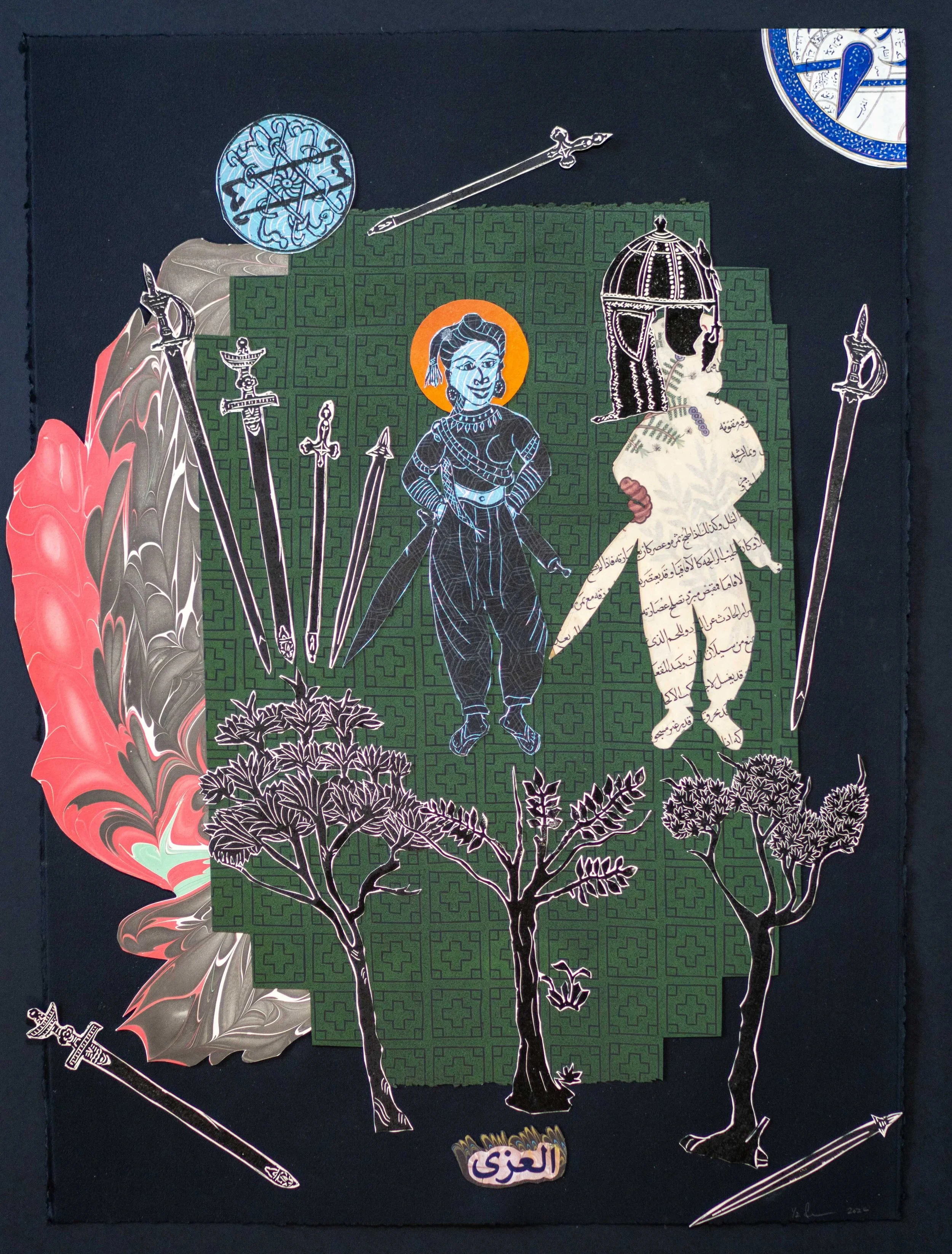
Uzza, Enlightener, 22 x 30 inches, Material: Lino cuts on letter press and French press prints on wasli paper and/or Rives Black and White papers, and hand marbled papers
Artist Statement and Bio
Statement: In a world of binaries, Khan challenges this notion. Neither black nor white, Khan and her practice sit at the African Arab Asian ocean world crossroads. A place where cosmopolitan cultures and ethnicities cross-fermented for millennia. Her making allows the engaged participants and collaborators to re-member pasts and re-unite with nuanced cultural histories hidden, erased, or distorted. Via cuisine, plants, or the senses, Khan re-introduces us to the beauty of multiplicities within ourselves and world.
Bio: Sarah K. Khan, multimedia maker/scholar, writes and makes art—paper, books, prints, photography, porcelain and films — about food, culture, women and migrants. Her work is informed from fieldwork and research globally. She has lived with Bedouins in Palestine and documented the plight of Indian women farmers. She traverses the world of Queens NY, and films women cooks and farmers about their foodways in Fez, Morocco. Her most recent bodies of works—prints, animation and porcelain—inspired by a 16th Century Central Indian Persian Cook/Book of Life from Central India, are a result of multiple residencies.
She studied Middle Eastern history (BA), public health and nutrition (MPH, MS) and traditional ecological knowledge systems/plant sciences in South Asia and China (PhD). A two-time Fulbright scholar, Khan has earned multiple art residencies, grants and fellowships. Details about her solo, group exhibitions, and film screenings are available here . Recent works have appeared in at BRIC Media Arts Gallery (Speak Sing Shout: We, Too, Sing America), Women and Migration(s), Reponses in Art History I, Women and Migration(s) II, the Museum of the Moving Image (films), Madison Children’s Museum, The Kimmel Gallery at NYU, Queens Museum, Asian Arts Initiative, and Asian American Writers Workshop Open City .
Her residencies include Anderson Ranch Residency (2024), Women Studio Workshop (2023), Kohler Arts/Industry Residency (2022), Princeton Artist-in-Residence ArtHx (2021-22), Ellis Beauregard (2021), Monson Arts (2021), Project for Empty Space Feminist Residency (2020), Indigo Arts Alliance (2019), and the Boren Chertkov Residency for Labor and Justice at Blue Mountain Center (2019). Her work has exhibited nationally and internationally and exists in permanent and private collections. @sarahkkhan
BACKGROUND
One theme of several that runs throughout the bodies of artwork is elevating and recognizing domestic women spaces as places of science, deep ecological knowledge, pleasure and defiance. And that these shero-femmes wield great powers of creativity and agency with the tools of their culinary and healing arts. My newly interpreted blue and white ware includes The Spoons: Poison or Pander and encompass other decorated foodware, weapons of mass creation and weapons of mass destruction such as Rolling Pins: Bake or Bludgeon, Lugers: Defend of Destroy, Scythes: Cultivate or Kill, Meat Mincers: Mince or Mutilate, Small Swords: Slit or Stab, 24K Gold-Leafed Jagged Knives: Carve or Cleave, Daggers: Relish or Rip, and so on.
I engage in storytelling via print making, photography and films. Upon receiving a Kohler Arts/Industry residency in 2022 to create in the Pottery, I learned the basics of slip cast molding, glazing and firing in the flagship Kohler factory setting. I created and learned alongside seasoned slip casters, plaster mold makers, professional glazers. And, I had at my disposal all the factory tools and machines. As a printmaker I often say, “Why make one when you can make a hundred?" With the assistance and knowledge of skilled artists and technicians at Kohler, I made multiples of foodware and weapons of mass creation/destruction that I saw and/or imagined in the cookbook. Simultaneously, I playfully imagine these femmes, endow them with nuanced lives and fabricate them beyond the confines of denied and erased histories. I assure futures by recasting the past.
Sarah Khurshid Khan’s
Flowers Coming Out of Their Mouths
Exhibition List
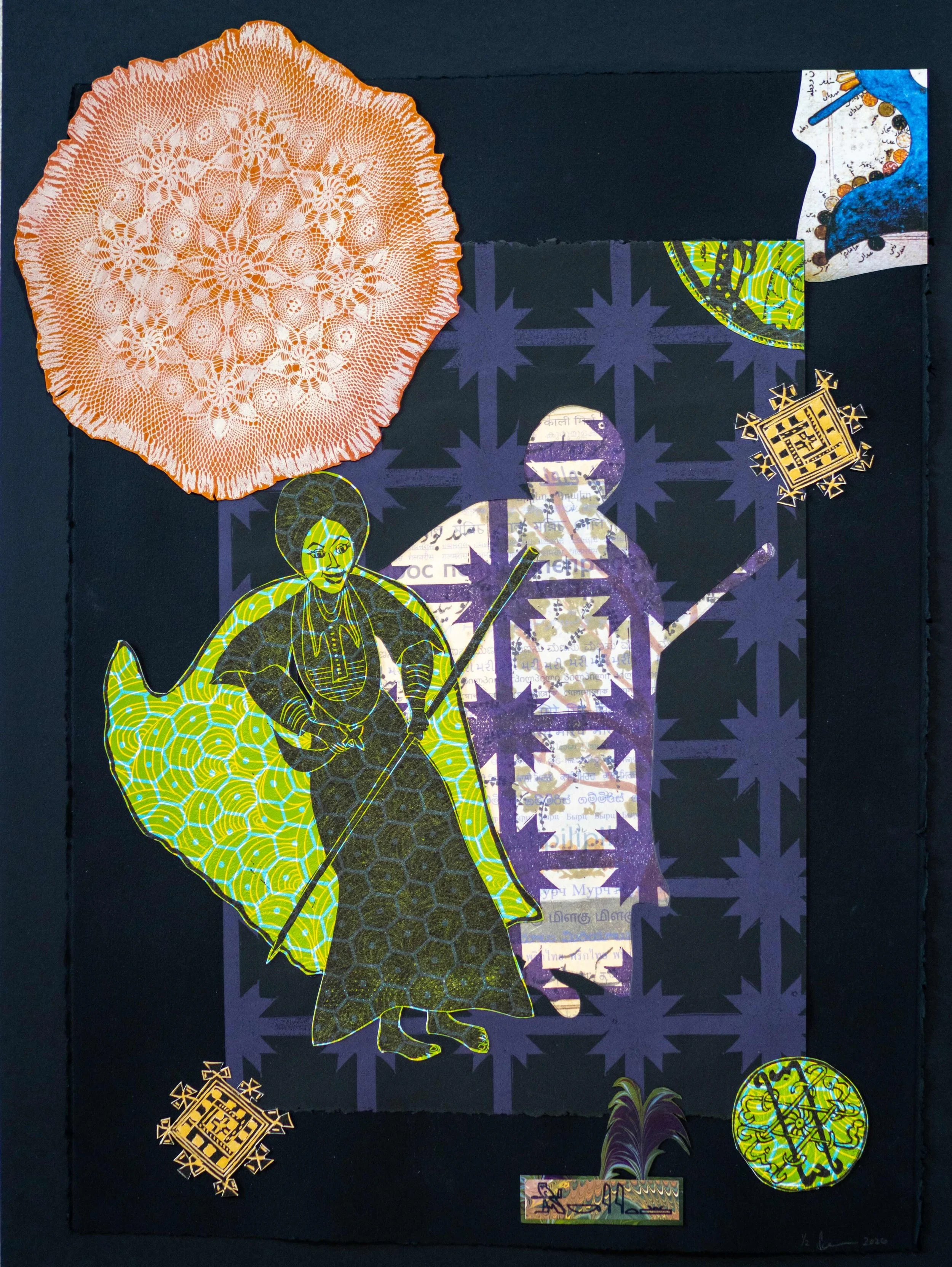
Bilqis, Defender, 22x 30 inches Material: Lino cuts on letter press and French press prints on wasli paper and/or Rives Black and White papers, and hand marbled papers $1500
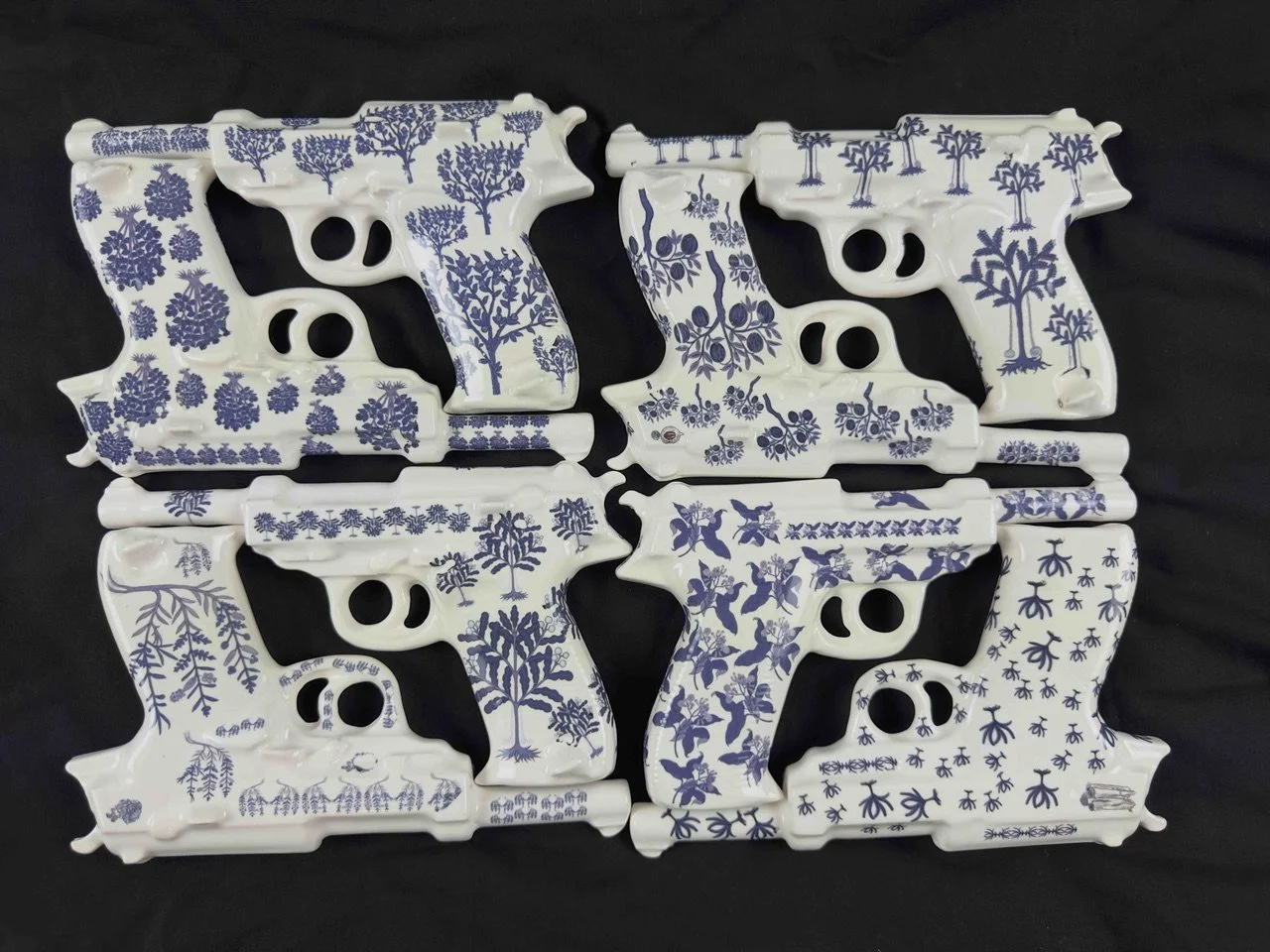
Lugers, Defend or Destroy? Defend or Destroy? Weapons of Mass Creation/Destruction, 8 blue and white porcelain Lugers covered in blue and white plants spices, 8.5 x 4.5 x 1 in., 2025 $500 ea. 3 of 8 SOLD
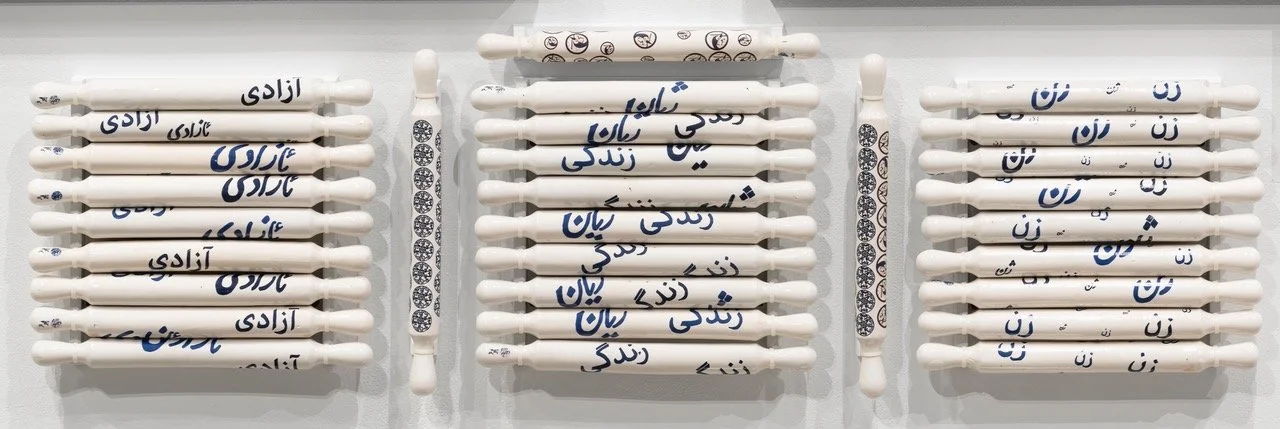
Rolling Pins, Bake of Bludgeon? Bake or Bludgeon, Women Life Freedom in Kurdish and Persian, 14.5 x 1.25 x 1.25 in., 2025 $500 ea. 3 SOLD
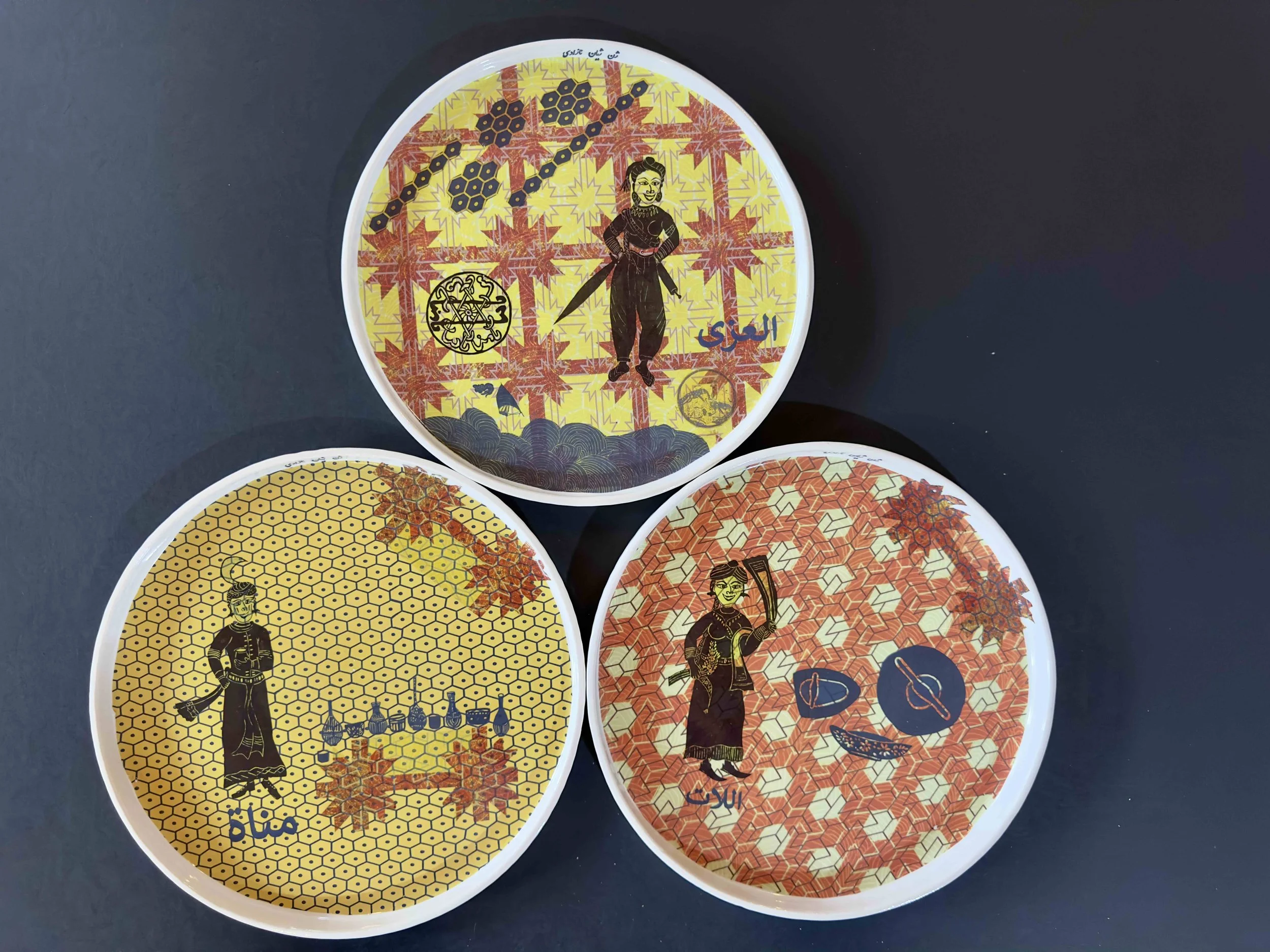
Enlighteners, Serve or Service?, 10 1/2"dia. porcelain plates. $500 ea.
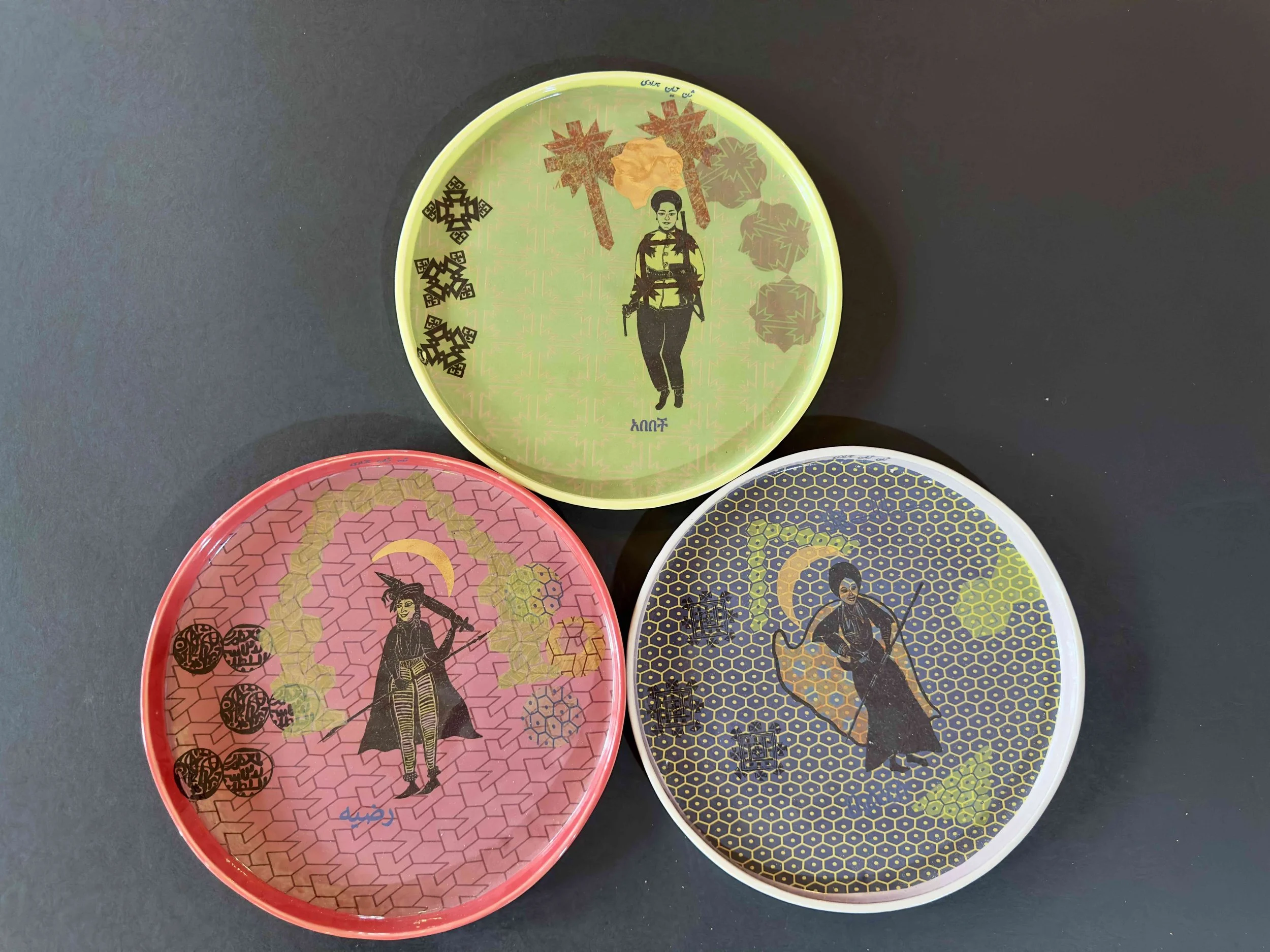
Defenders, Serve or Service?, 10 1/2"dia. porcelain plates. $500 ea. Upper and Left SOLD
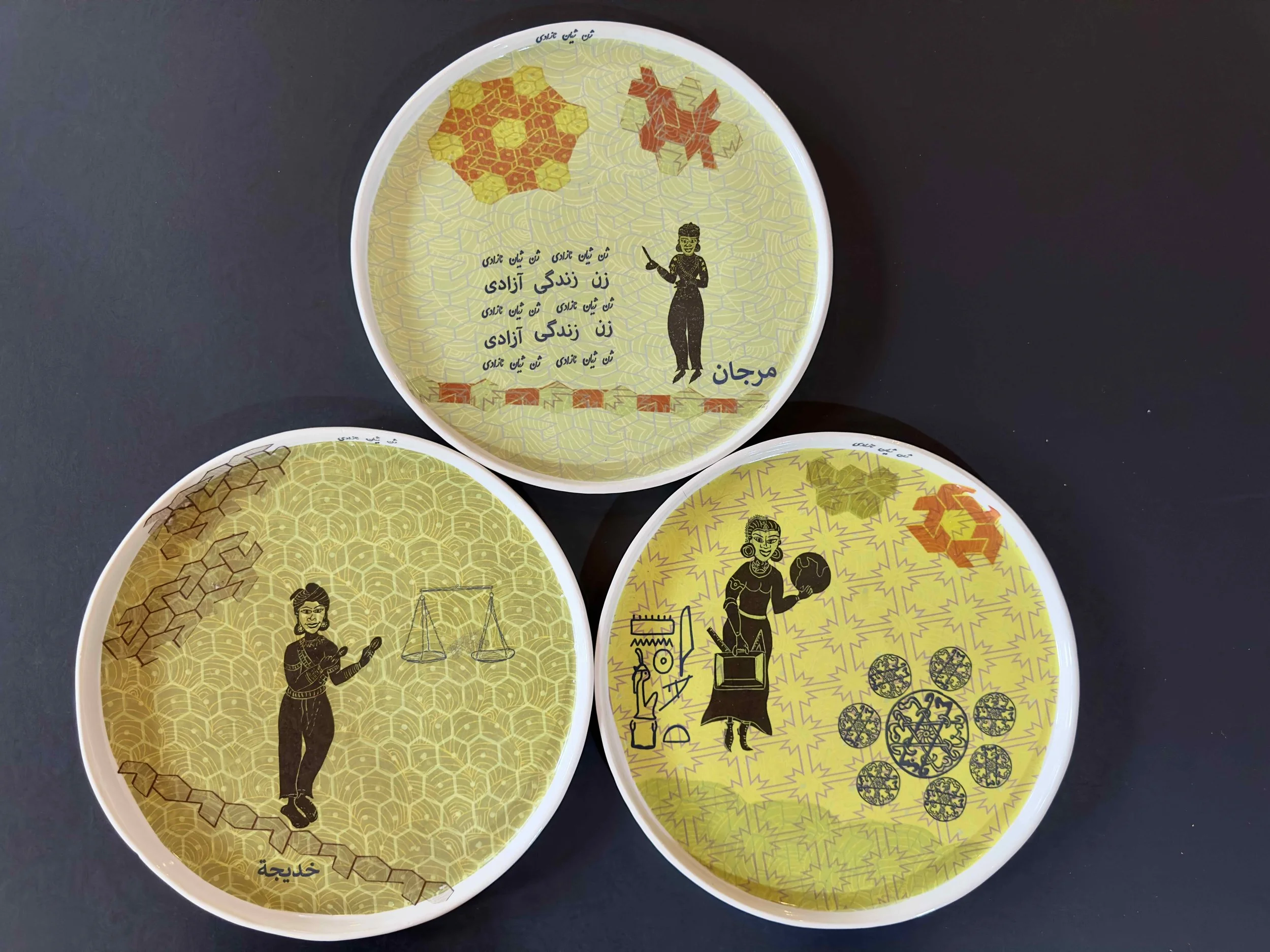
Professionals, Serve or Service?, 10 1/2"dia. porcelain plates. $500 ea.
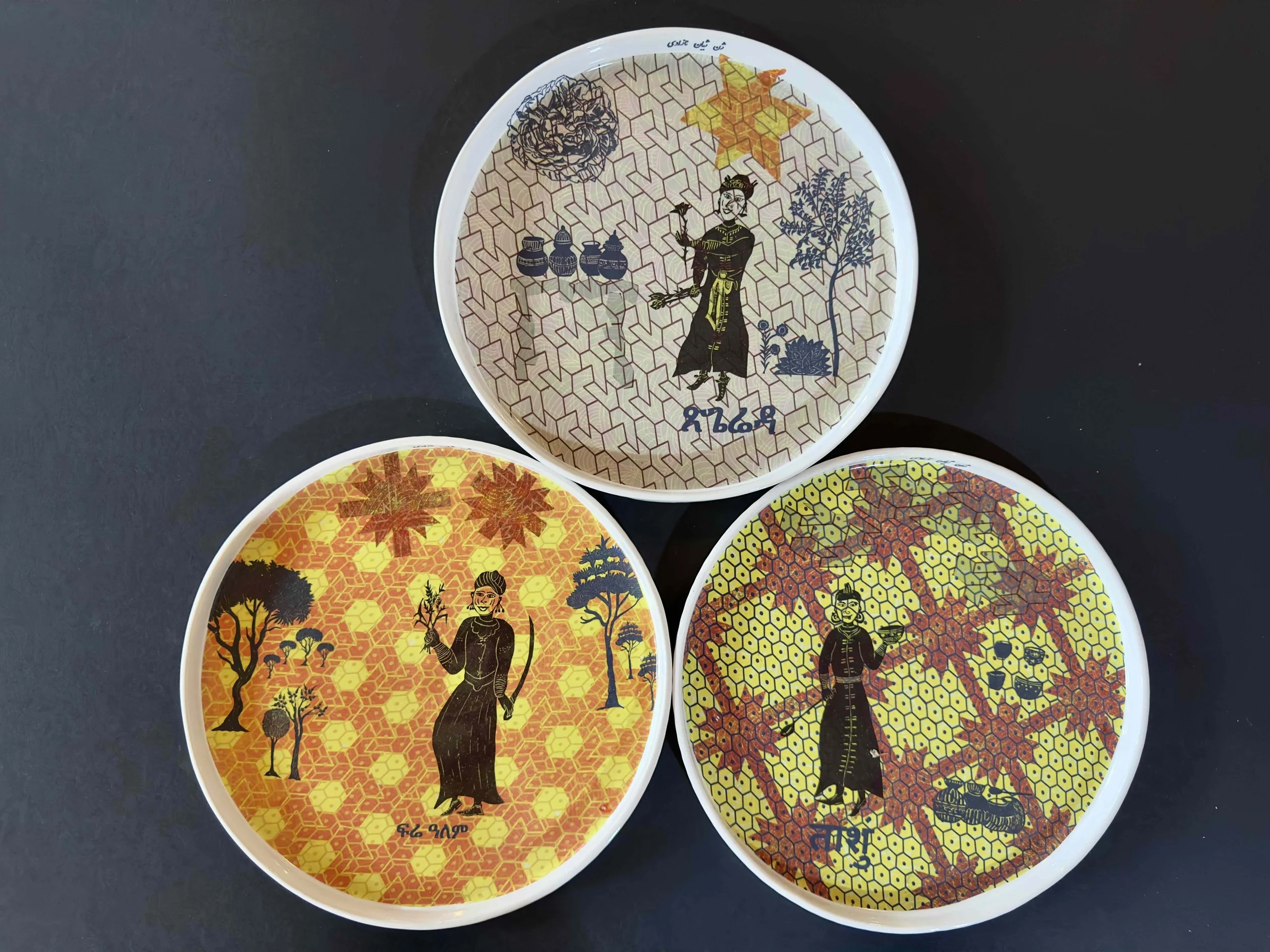
Foragers, Serve or Service?, 10 1/2"dia. porcelain plates. $500 ea.
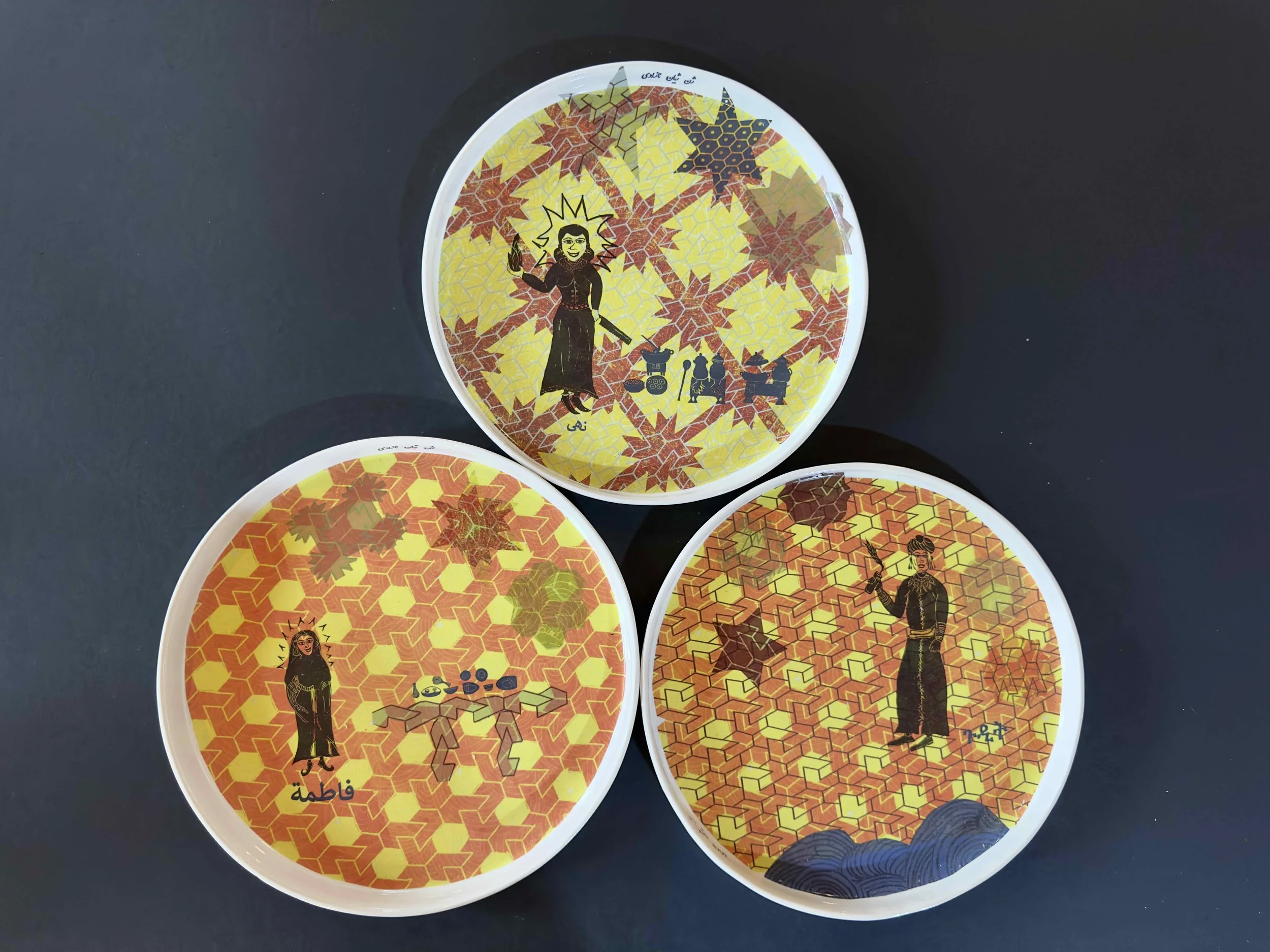
Alchemists, Serve or Service?, 10 1/2"dia. porcelain plates. $500 ea.
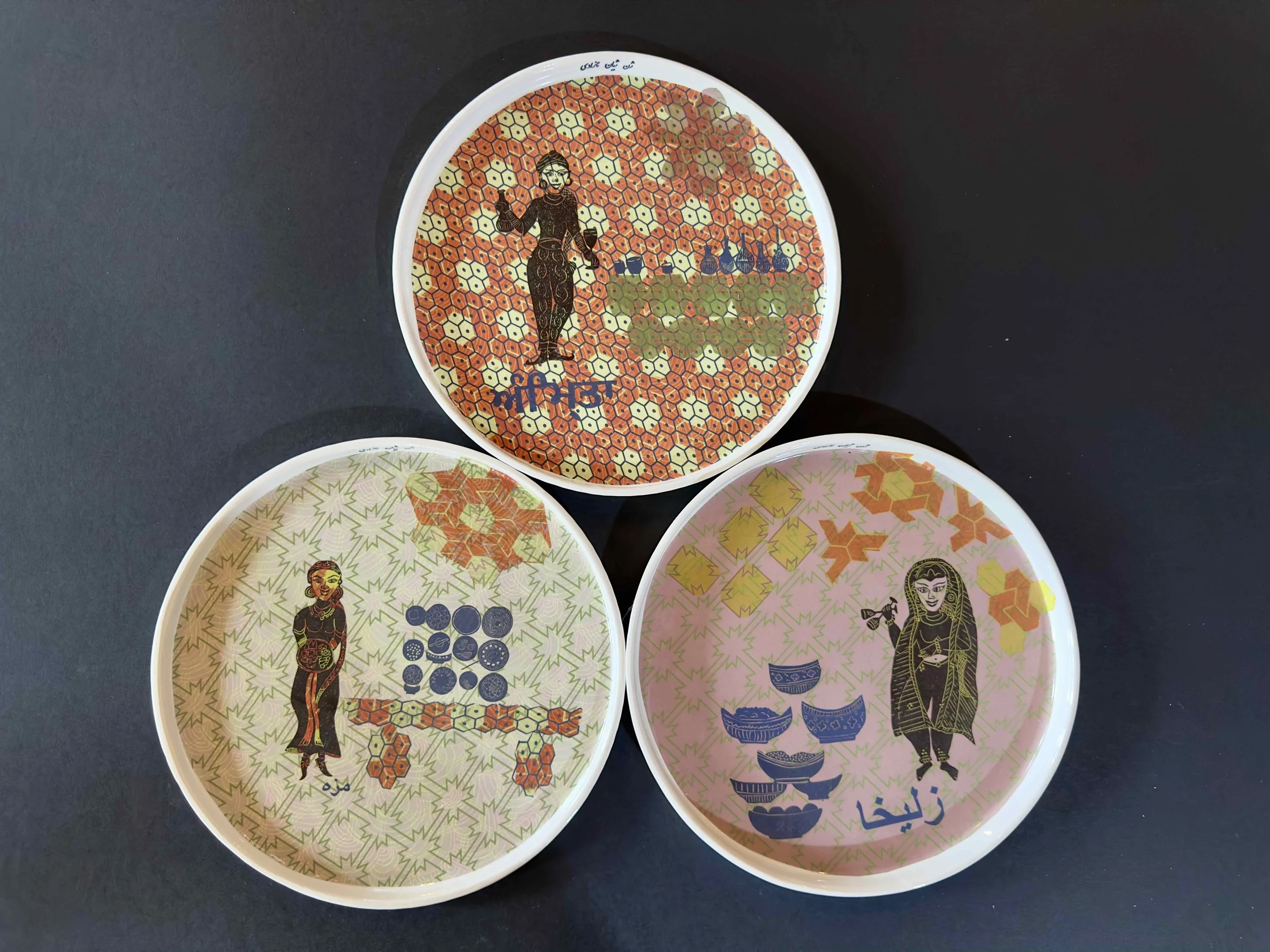
Revelers, Serve or Service?, 10 1/2"dia. porcelain plates. $500 ea.
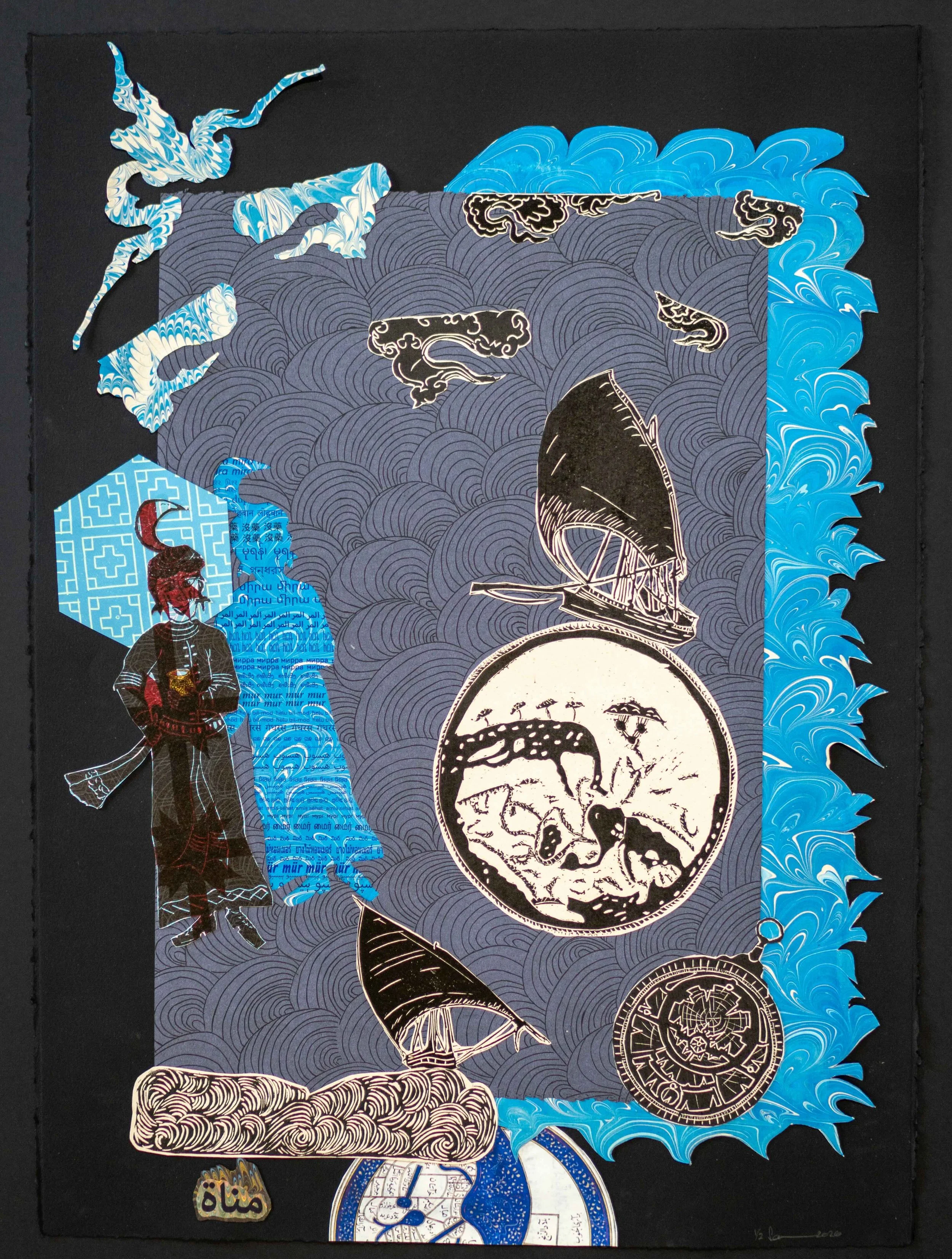
Manat: Enlightener Pre-Islamic goddess Manat, blue and white marbled clouds, marbled papers, ancient Dhows, Al-Idrisi and KMMS maps, astrolabe, Manat with golden chalice, waves inspired from Ottoman miniature waves under Noah’s ark, myrrh in multiple languages printed on marbled papers. Al Idrisi 1154 circular world map with North as South, etc. unifies the triptych. “We may also ride the African Arab Asian ocean waves together. Our regions are fluid, our waters connect us, our heart cultures are global.” (22x 30 inches. Materials: lino cuts on letter press and large press prints on wasli paper and/or BFK Rives black paper, with hand marbled papers 2026) $1500
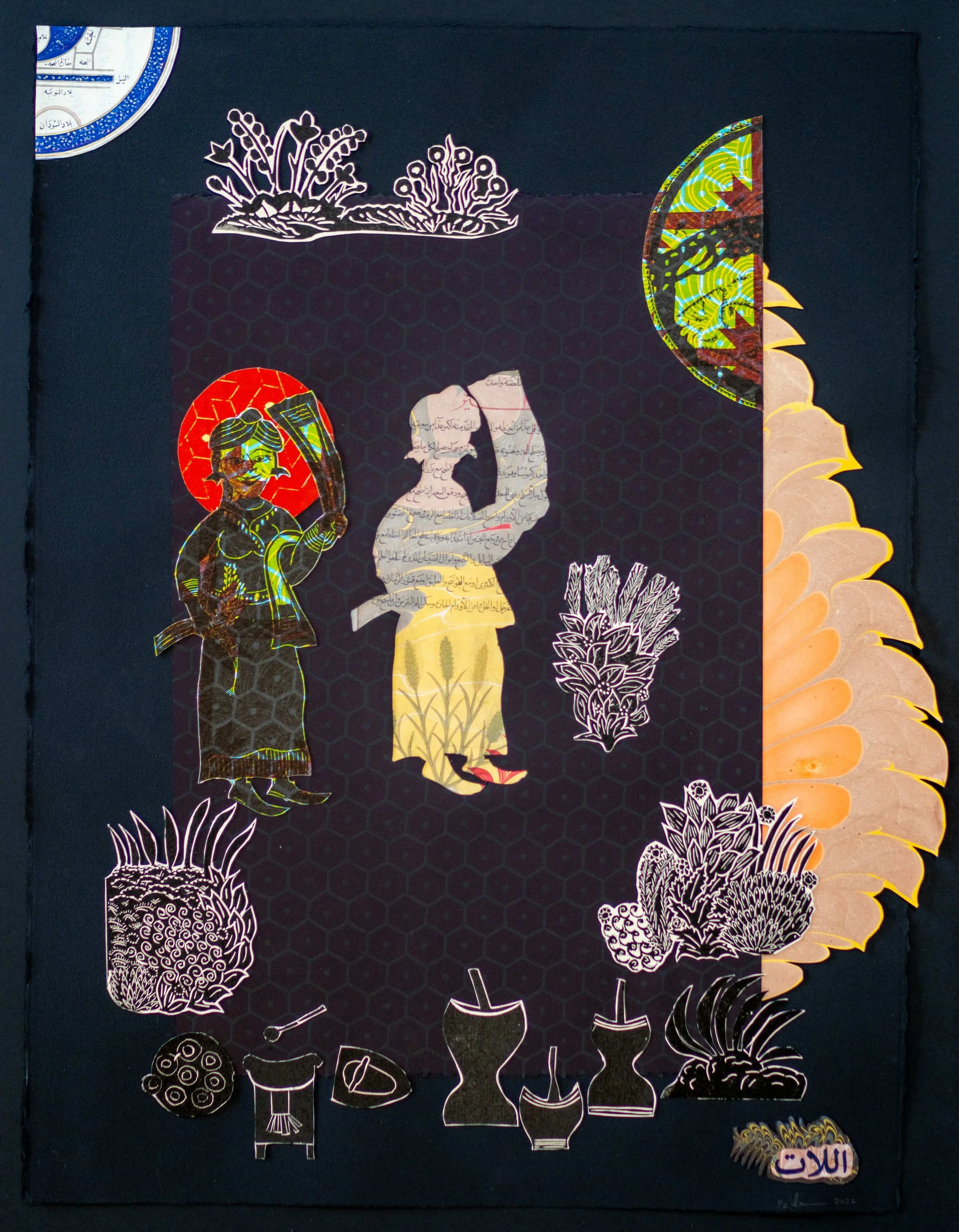
Lat: Enlightener To knead, al-lat (may also mean Allah). Barely, older grains, surrounded with barley-like plants. Barley plant represented from NYPL Tibb manuscript. Surrounded with mortar and pestles, rolling pins, and ovens. Al Idrisi 1154 circular world map with North as South, etc. unifies the triptych. “The bounty of our seasons, rich with barley, teff, whole grains, and love.” (22x 30 inches. Materials: lino cuts on letter press and large press prints on wasli paper and/or Rives Black and White papers, with hand marbled papers 2026) $1500
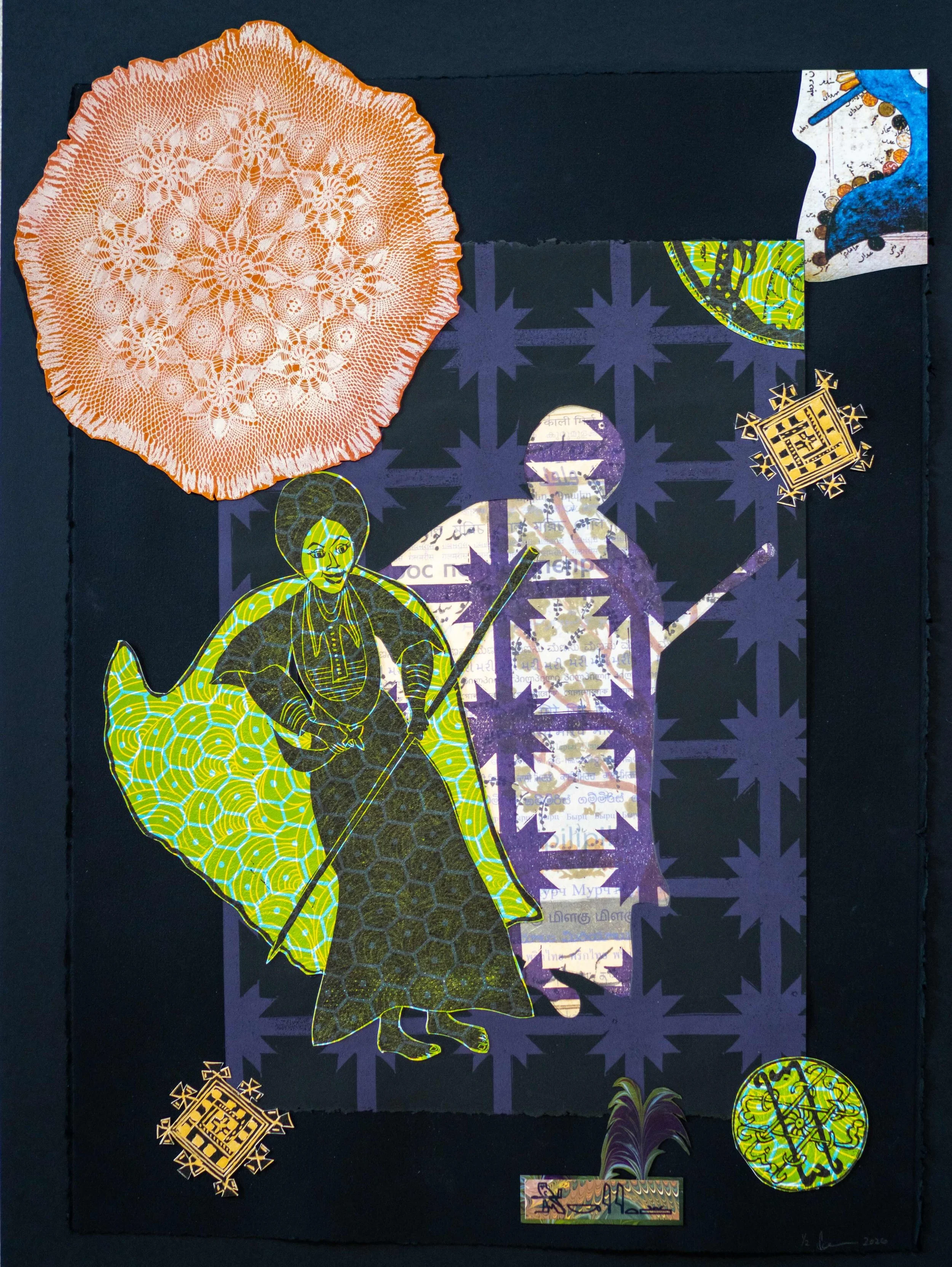
Uzza: Enlightener Pre-Islamic U/Azza. With sword and rolling pin, defender also. Bake or bludgeon. Historically associated with three Acacia trees that were destroyed. Acacia plant image from NYPL Tibb (check). Al Idrisi 1154 circular world map with North as South, etc. unifies the triptych. “I chose the bows and arrows to pack on our hunting expedition in the winter months. Gratefully, Fere Alem advises us how to live independent and sustainable.” (22x 30 inches. Materials: lino cuts on letter press and large press prints on wasli paper and/or BFK Rives Black and White papers, with hand marbled papers 2026) $1500
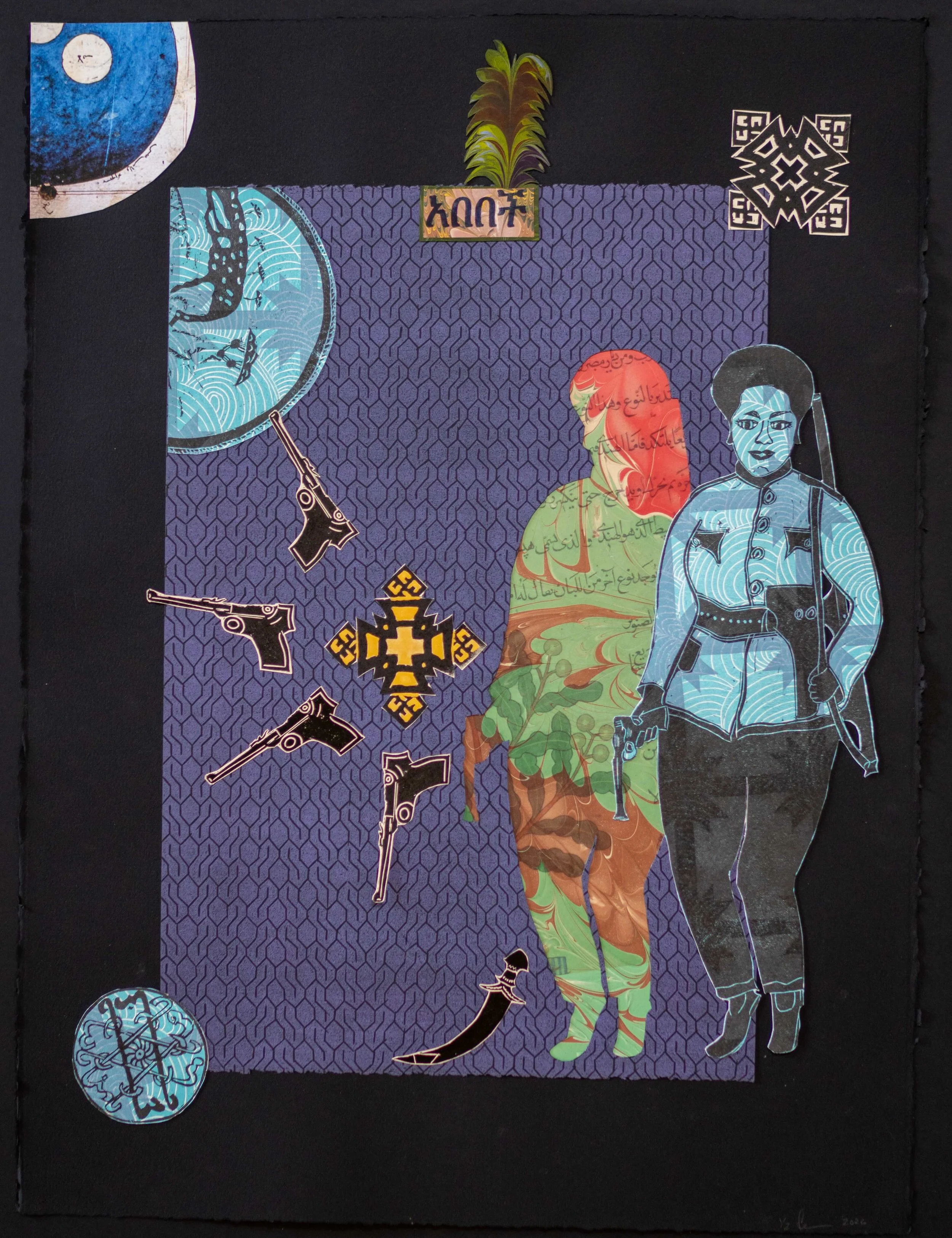
Abebach: Defenders Abebach was an Ethiopian freedom fighter against Italian fascism during WWII, who wielded a rifle and a German Lugar. Frankincense from the NYPL Tibb manuscript printed on loosely marbled paper reminiscent of the marbled paper identified in the Deccan in a book for Ghiyath Shah, 1469. Coptic patterns are a background pattern found in the Ni’matnāma. A dagger from a Mughal miniature painting of Malik Ambar’s son and the dagger he wields. For this triptych a map of the Persian Gulf from Istakhri maps unifies them. “Sisters, we need to study military science, learn how to fight with a rifle, a machine gun, a knife, so we can help our loved ones fight against a cruel enemy.” (22x 30 inches. Materials: lino cuts on letter press and large press prints on wasli paper and/or Rives Black and White papers, with hand marbled papers 2026) $1500
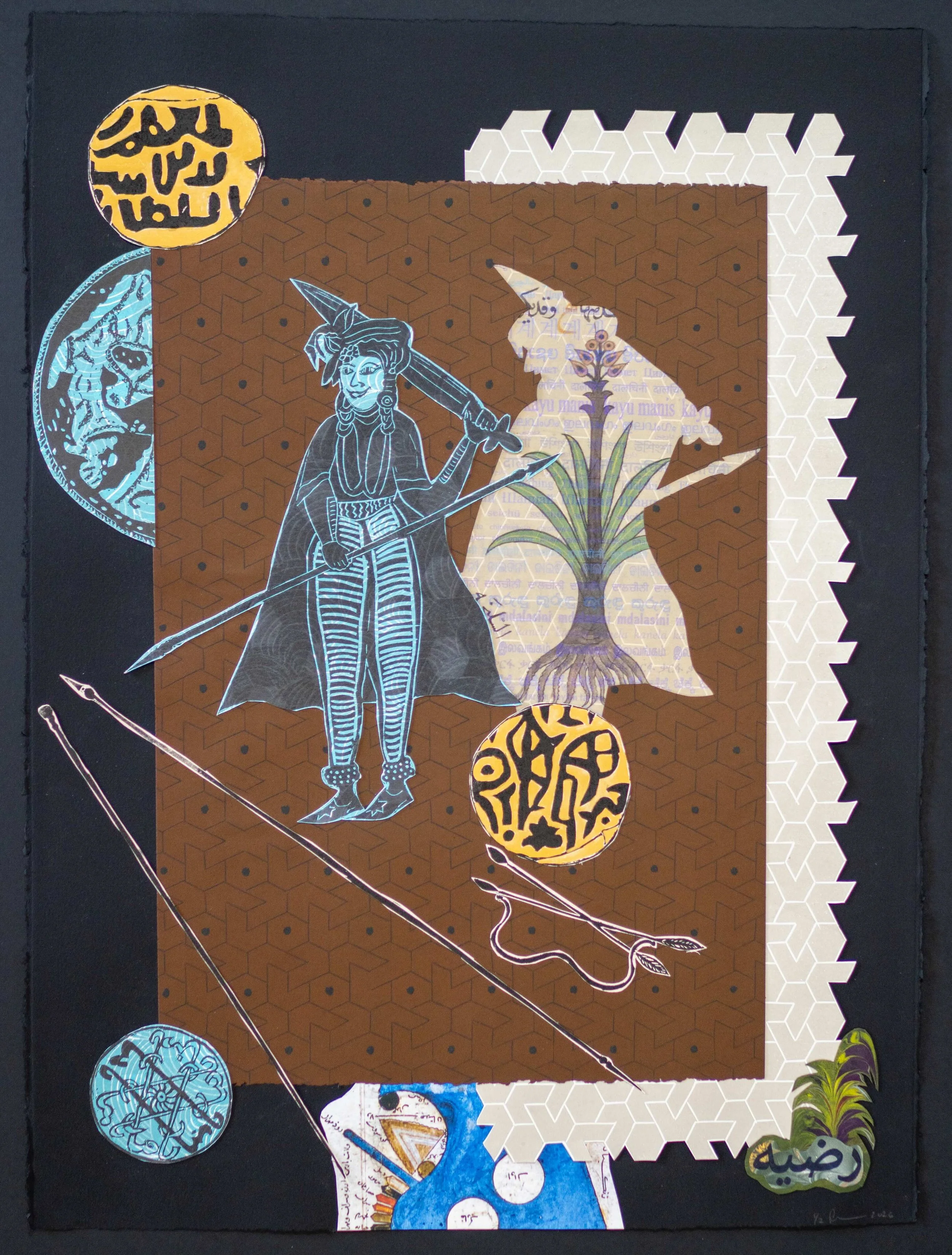
Razia: Defenders Razia is graced with a stylized cinnamon plant from the NYPL Tibb manuscript. Overlaid on the manuscript page are polyglot names in diverse scripts of the word cinnamon. She stands on her coinage, the one that represents a woman on a horse. Spears, bows and arrows, with origins from other miniature paintings, surround her. She stands with a backdrop of one of several patterns from the book of delights. For this tryptic a map of the Persian Gulf from Istakhri maps unifies them. “We are to receive, lovingly, the brave Ethiopian maid-servant. She deserves a sheroic welcome. The Deccan zenana/harem loathed the homicidal maniac, Zalim the tyrant. Irresponsibly drunk, his rule ended abruptly when, in self-defense, she stabbed him to death.” (22x 30 inches. Materials: lino cuts on letter press and large press prints on wasli paper and/or Rives Black and White papers, with hand marbled papers 2026) $1500
Bilqis: Defenders Queen of Sheba, Queen Bilqis, also the name of my mother. Top left is a screen print based on a photograph of a textile that my Nani (mother’s mother) made 70-80 years ago. Bilqis, claimed by Ethiopians and Arabs, has purple Coptic patterns in the background and her double has black pepper, a spice whose worth was weighed in gold, in her body. Also overlaid on the manuscript page are polyglot names in diverse scripts of the word black pepper. For this tryptic a map of the Persian Gulf from Istakhri maps unifies them. “How are you developing our pharmacopeia for our community these days?” (22x 30 inches. Materials: lino cuts on letter press and large press prints on wasli paper and/or Rives Black and White papers, with hand marbled papers 2026) $1500
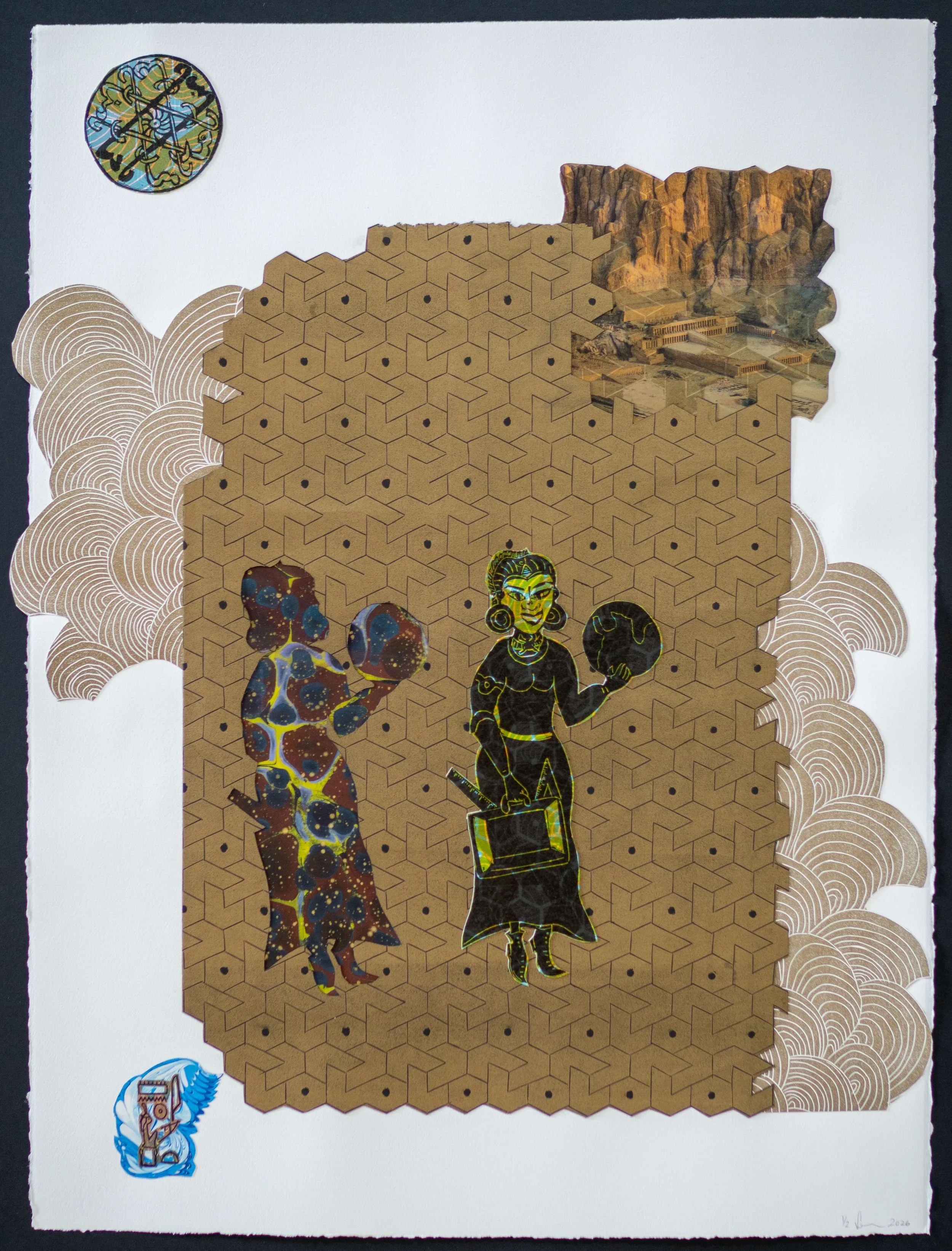
Hatshepsut: Professionals Female Pharoah architect. Marbled paper spackled with gold glitter to invoke the vast cosmos. A photo of her immense tomb in Egypt. Surrounded with dry arid places, yet the waves under Noah’s ark from an Ottoman miniature nourish her. Her name in hieroglyphics. “Tashu, help us forage for plants on the Siddi island of Janjira with the specific goal to seduce a lover. Manat and Fatima will provide recipes for aphrodisiacs.” (22x 30 inches. Materials: lino cuts on letter press and large press prints on wasli paper and/or Rives Black and White papers, with hand marbled papers 2026) $1500
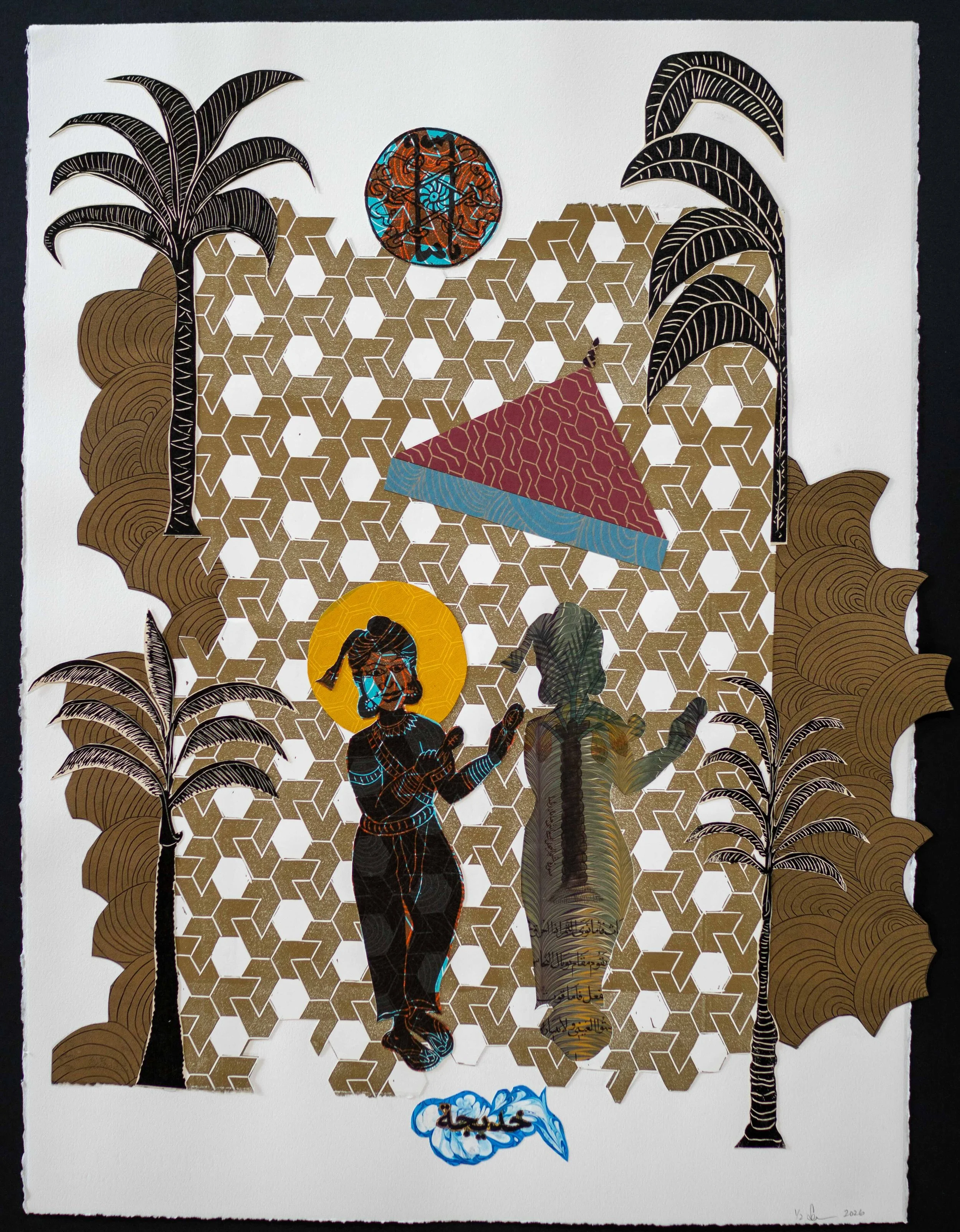
Khadija: Professionals Khadija, prophet Muhammad’s wife, older, wiser, astute business woman who funded a religion. Cowries in her hands to represent her wealth, and depending on whose accounts you read, she had multiple past husbands. A woman of means and business acumen. In the dessert, surrounded with date palms and a date palm image from NYPL Tibb manuscript. And Noah’s waves support, nourish, and have a parallel image of sand dunes. “We will Woman Up! We envision and support dynamic futures for all.” (22x 30 inches. Materials: lino cuts on letter press and large press prints on wasli paper and/or Rives Black and White papers, with hand marbled papers 2026) $1500
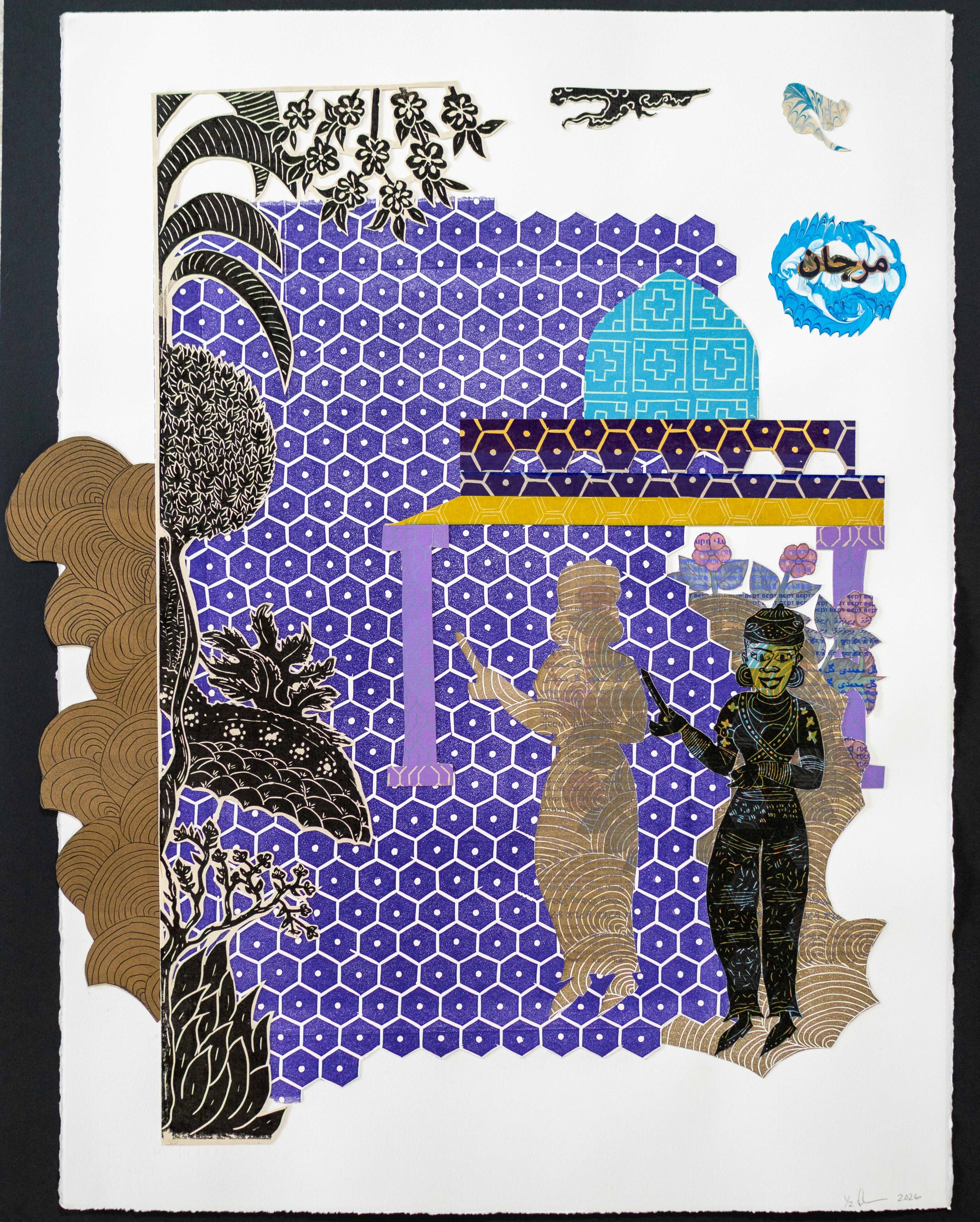
Marjane: Professionals In honor of Marjane Satrapi who wields a pen as her weapon of mass creation. She is protected in a room of her own. Roses of Ararat from NYPL Tibb manuscript adorn her body and landscape. Ararat is associated broadly with Armenian culture and a symbol of Armenia. And Noah’s waves support, nourish, and have a parallel image of sand dunes. “Yes, we ensure women, life, and freedom for all.” (22x 30 inches. Materials: lino cuts on letter press and large press prints on wasli paper and/or Rives Black and White papers, with hand marbled papers 2026) $1500
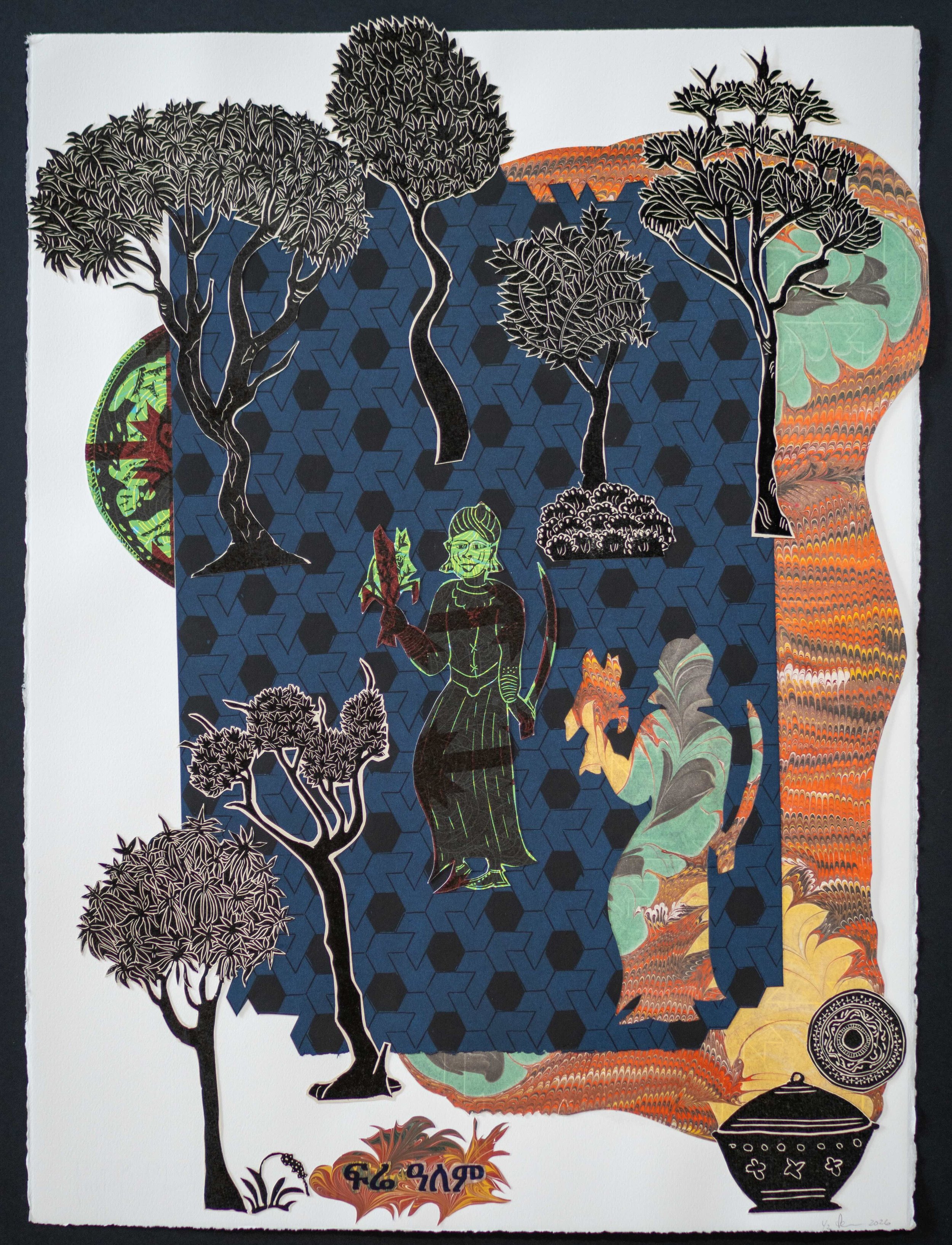
Fere Alem: Foragers Fere Alem (fruit of the world in Amharic) holds a bunch of teff, a grain significant to East African food and culture. Surrounded with marbled papers as partial margins and borders, Fere Alem is content in the forest amidst diverse flora. In the lower right corner lies a container to hold teff and a plate on which to put it when served. “We must avert climate catastrophe and develop systems that are from the people, by the people, for the people.” (22x 30 inches. Materials: lino cuts on letter press and large press prints on wasli paper and/or Rives Black and White papers, with hand marbled papers 2026) $1500
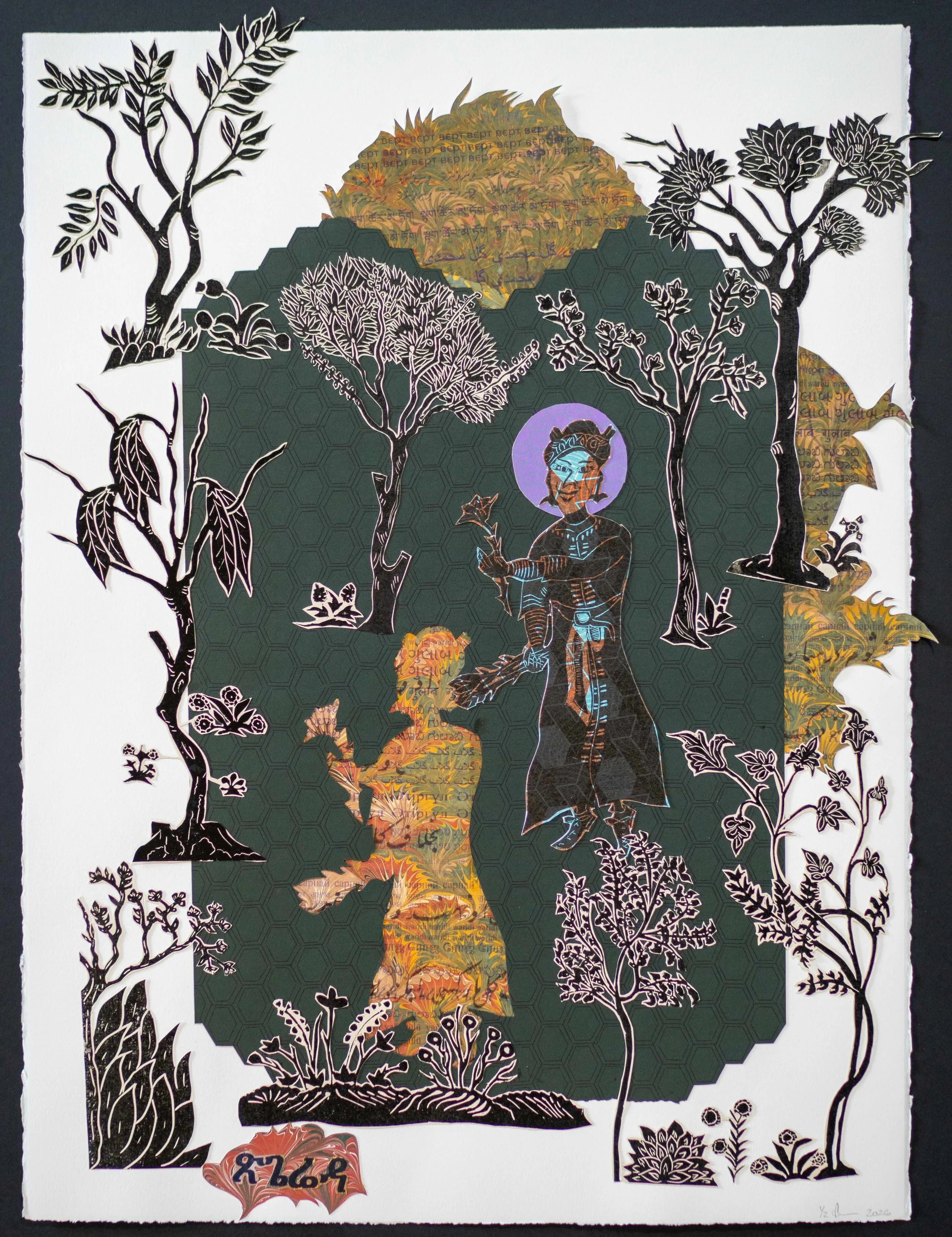
Tsigerada: Foragers Tsigerada means rose in Amharic. Another rose plant found in NYPL Tibb manuscript printed on marbled paper adorns the body. The marbled paper with the rose plant emerges from the top while a cut out of the marbled paper emerges from the right frame. There is movement and vibrancy, as the sinewy flora breaks free of the rectangle, while the black against a white background provides more clear lines. “We will neither define you nor rule you. We span the seas. We are open to all.” (22x 30 inches. Materials: lino cuts on letter press and large press prints on wasli paper and/or Rives Black and White papers, with hand marbled papers 2026) $1500
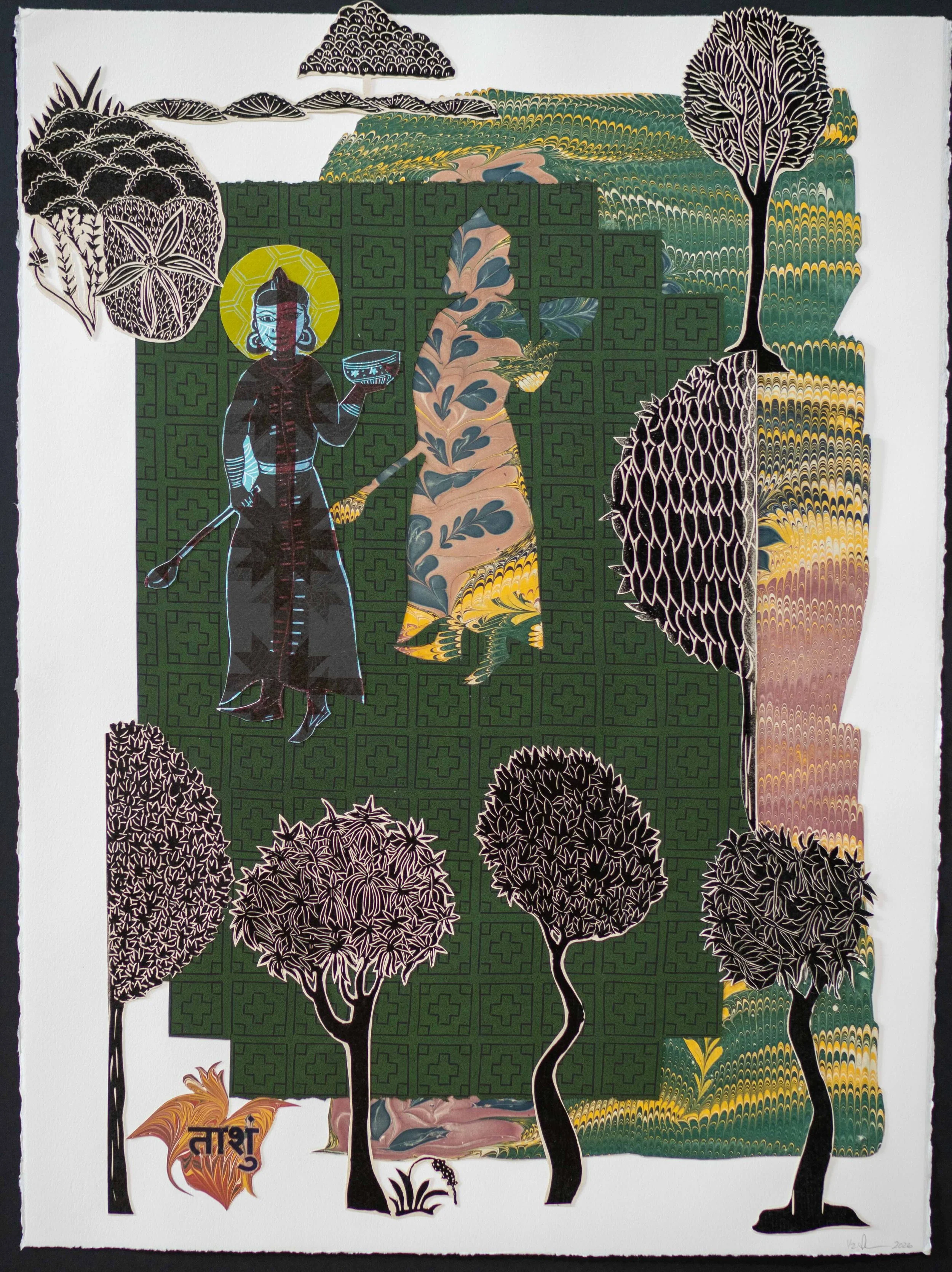
Tashu: Foragers Another forager, in the lush dark forest filled with diversity and pharmacopeias. Talented in many ways. “Hatshepsut, may you help us imagine a world with architecture grounded in place and for the people?” (22x 30 inches. Materials: lino cuts on letter press and large press prints on wasli paper and/or Rives Black and White papers, with hand marbled papers 2026) $1500
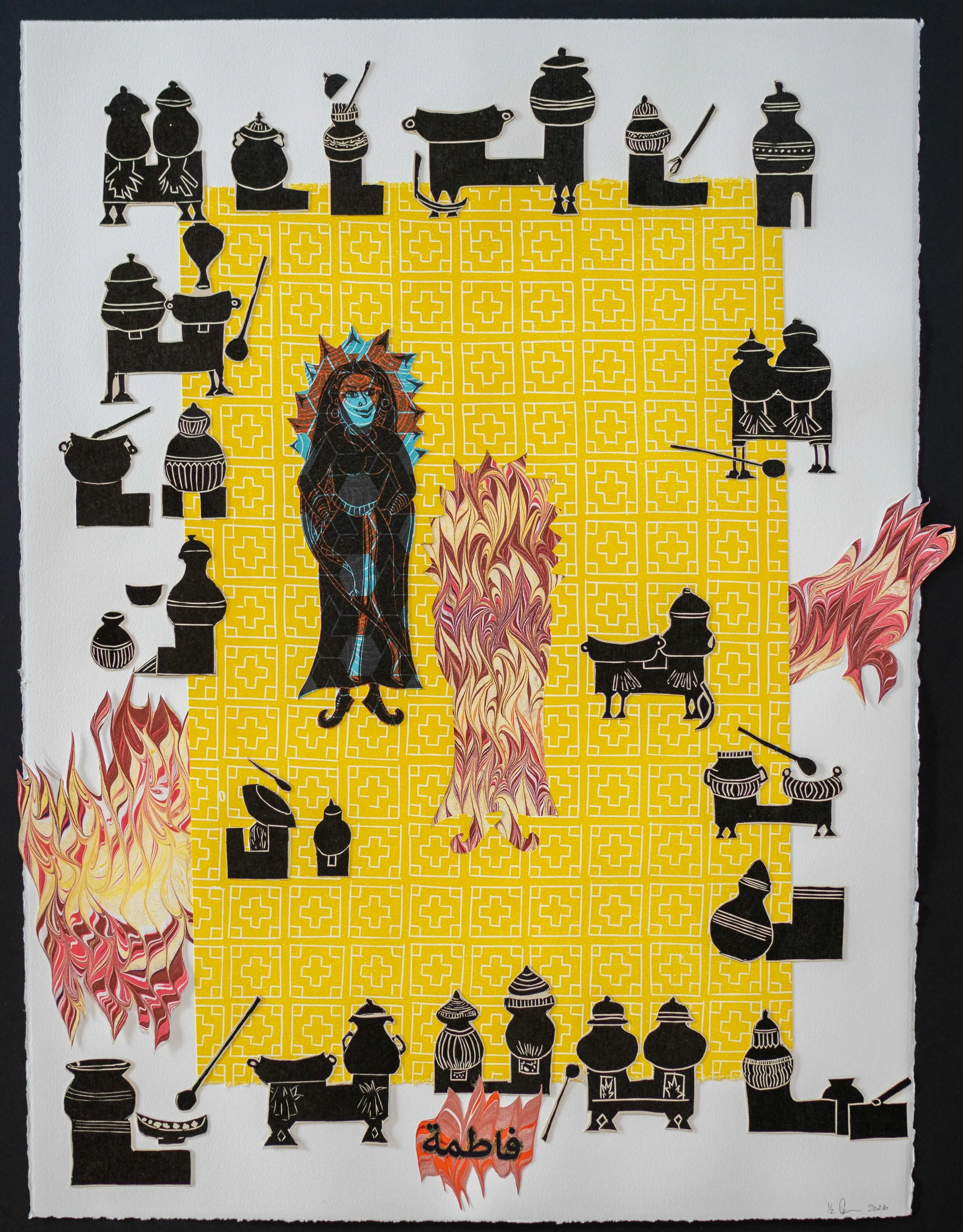
Fatima: Alchemists Prophet Muhammad’s (SA) daughter known for her deep generosity. “What shall we conjure in the kitchens these next weeks?” (22x 30 inches. Materials: lino cuts on letter press and large press prints on wasli paper and/or Rives Black and White papers, with hand marbled papers 2026) $1500
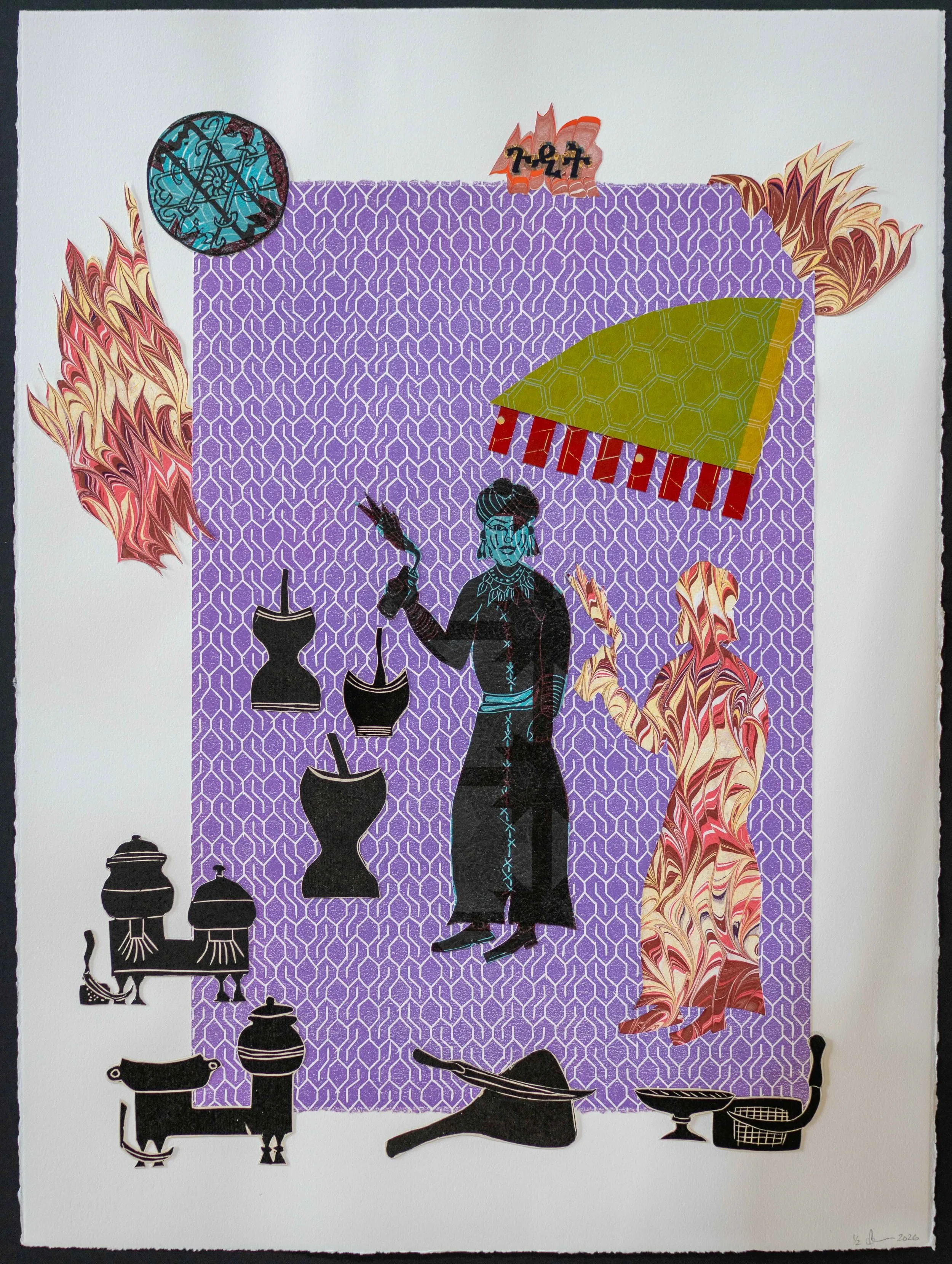
Gudit: Alchemists Origins in Ethiopia and claimed by Muslims,and Jews, a queen of power and force. “Did you hear the good news of those spirited Bengali Siddis who overthrew inept and corrupt overlords and then ruled for seven years? Now expelled, they are making their way to Mandu. Let us welcome them, too, into our effervescent communities.” (22x 30 inches. Materials: lino cuts on letter press and large press prints on wasli paper and/or Rives Black and White papers, with hand marbled papers 2026) $1500
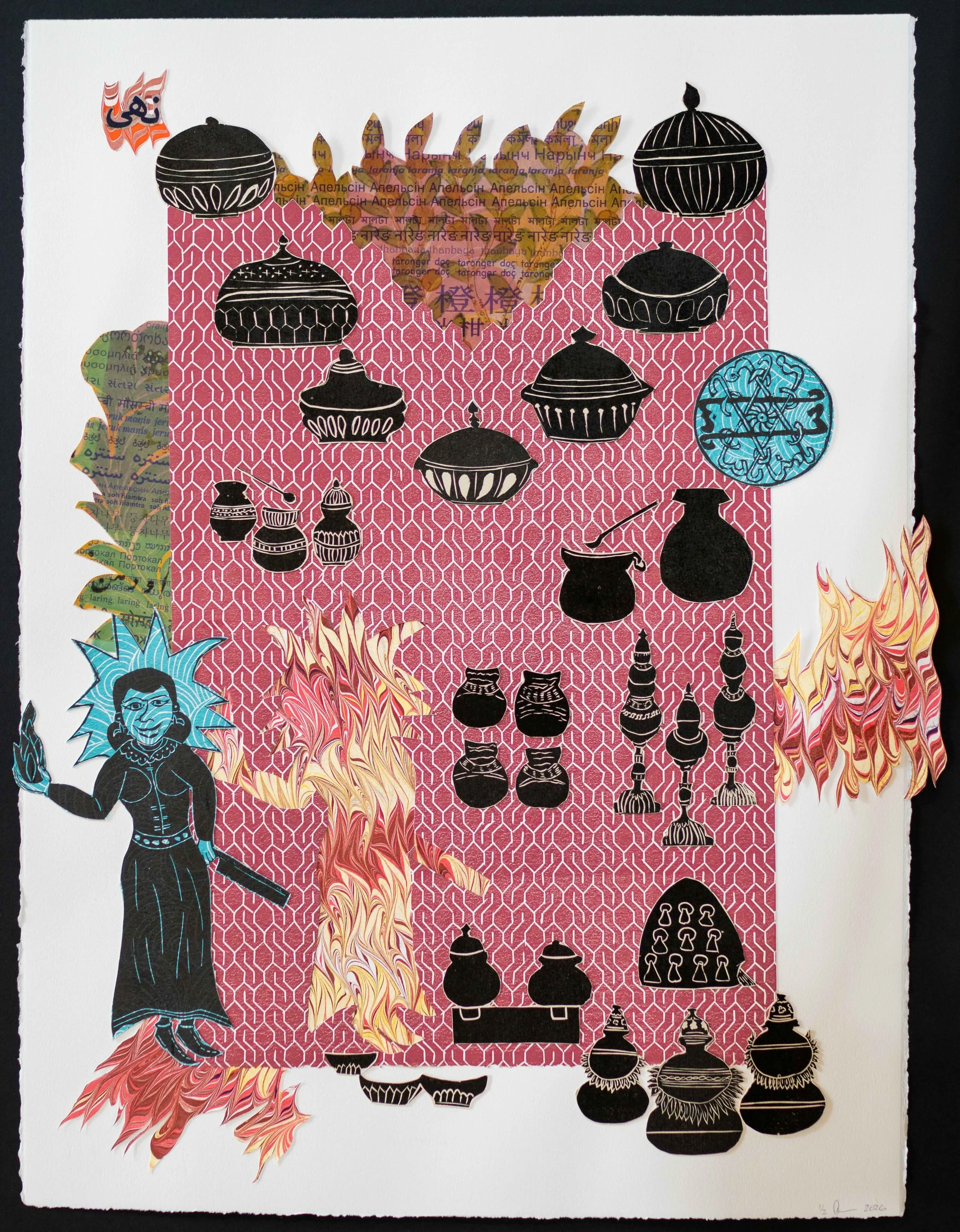
Nuha: Alchemists A gifted alchemist with the tools of transformation to alter materials, foods, elixirs, aphrodisiacs, medicines and more. Displays intelligence and intellect. “This season, we distilled Roses of Ararat and Central Asian Roses, based on Marjane’s advice, from fresh and perfectly unwilted petals. We anoint all who join us.” (22x 30 inches. Materials: lino cuts on letter press and large press prints on wasli paper and/or Rives Black and White papers, with hand marbled papers 2026) $1500
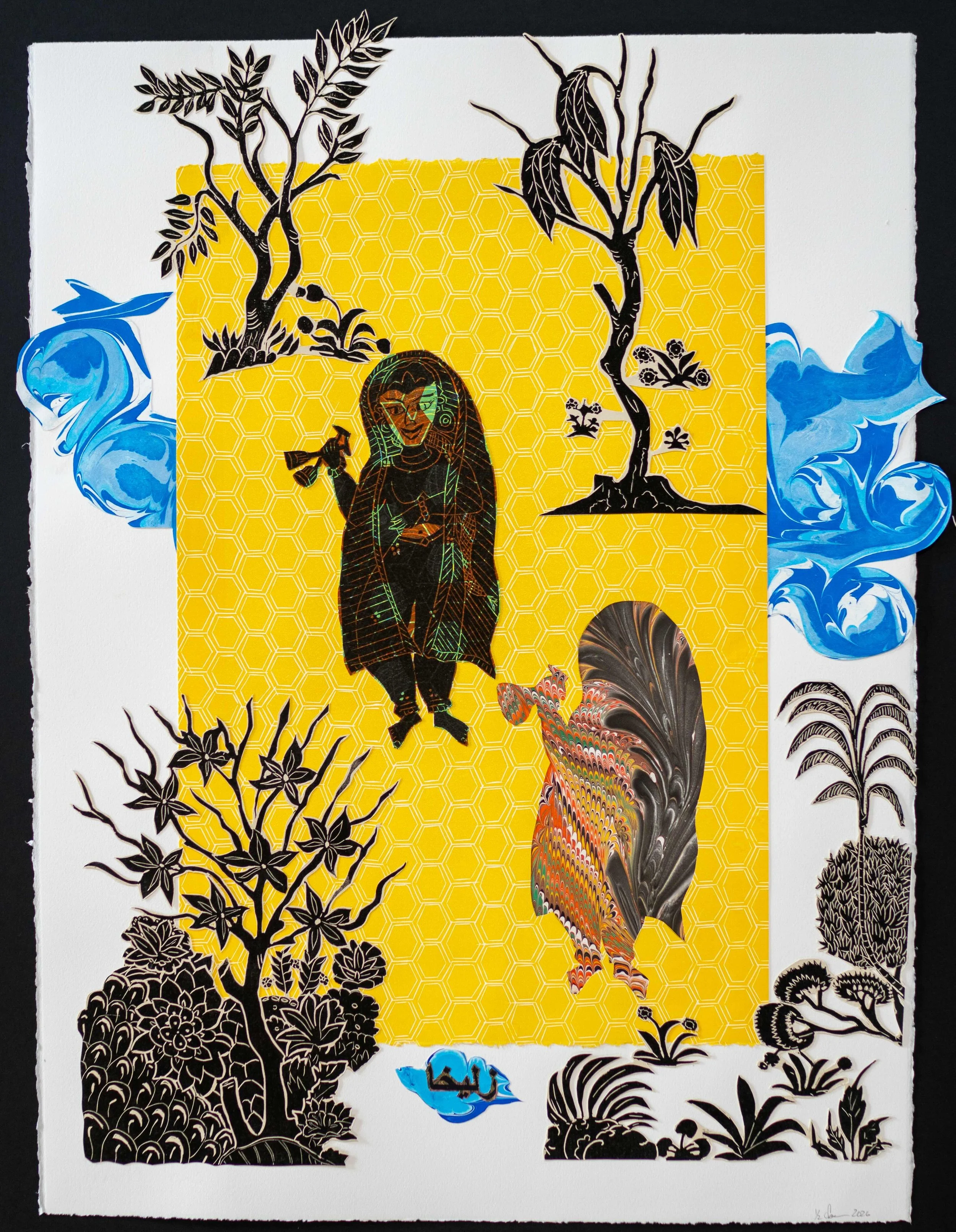
Zuleikha: Revelers Maligned for seduction, perhaps she was just responding to her needs. Here she is reveling in her beauty amidst powerful flora. “I will ensure we are ready for all things pleasurable: luscious textiles infused with essences, attars of healing, and foods from the earth, worthy for all.” (22x 30 inches. Materials: lino cuts on letter press and large press prints on wasli paper and/or Rives Black and White papers, with hand marbled papers 2026) $1500
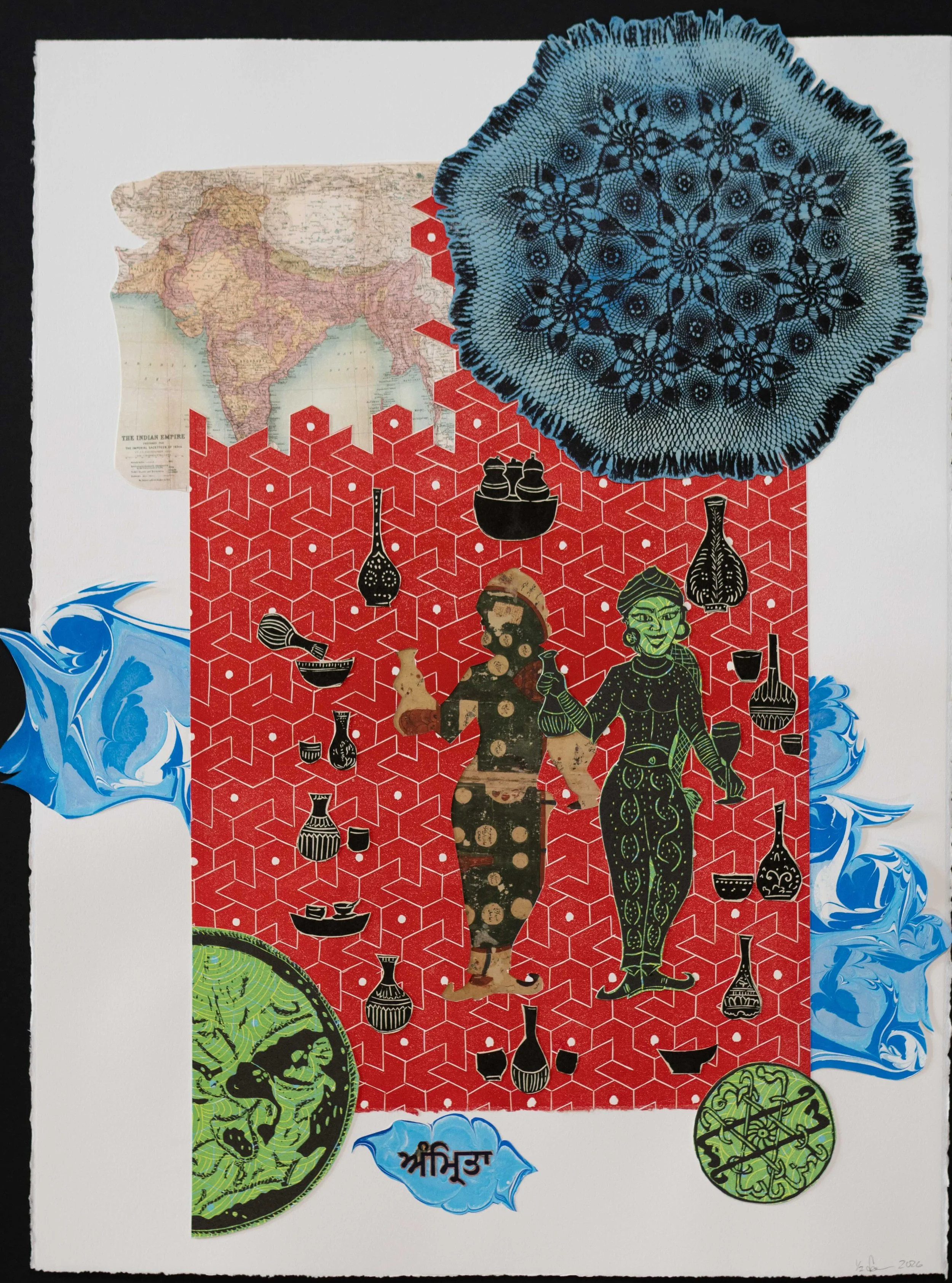
Amrita: Revelers The artist’s alter ego, Amrita Simla, in honor of her father’s birth in Simla and living in Amritsar (amrita = nectar or soma) and Simla as a youth. Adorned with a British Gazetteer’s map of South Asia before partition and protected with her grandmothers textile, another type of amulet. Her name is written in the Punjabi Gurmukhi script. “Across and beyond the nation-states, we must reclaim our regionality as a badge of richness, diversity, and beauty.” (22x 30 inches. Materials: lino cuts on letter press and large press prints on wasli paper and/or Rives Black and White papers, with hand marbled papers 2026) SOLD
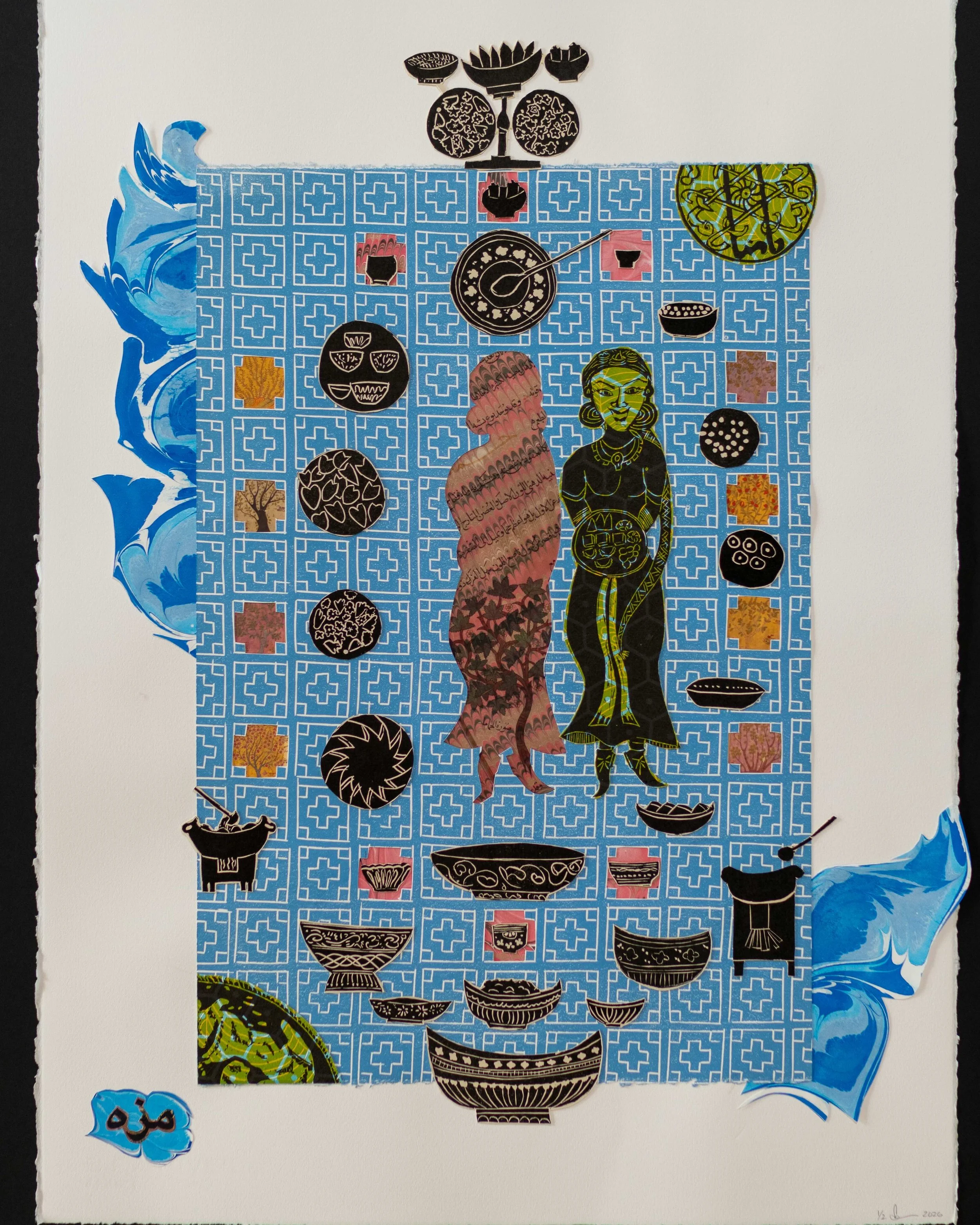
Maza: Revelers Etymology and overlap of the word maza in Urdu, Hindi, Persian, Punjabi and Arabic and more. Linguistics show our connectivity as regional and not as divided nation-states. A cardamom plants grows in her body as depicted in NYPL Tibb manuscript. Right side down: citron, pomegranate, plum, pear, up the left side: peach, pistachio, apricot and sumac. All stylized visuals of plants from the Persian MS 49 at NYPL. “Flowers flew out of my mouth as I recited my favorite poem by Bulleh Shah says: ‘You have learned so much and read a thousand books. Have you ever read your self? You have gone to mosque and temple. Have you ever visited your soul? You are busy fighting Satan. Have you ever fought your ill intentions? You have reached into the skies, but you have failed to reach what is in your heart!’” (22x 30 inches. Materials: lino cuts on letter press and large press prints on wasli paper and/or Rives Black and White papers, with hand marbled papers 2026) $1500
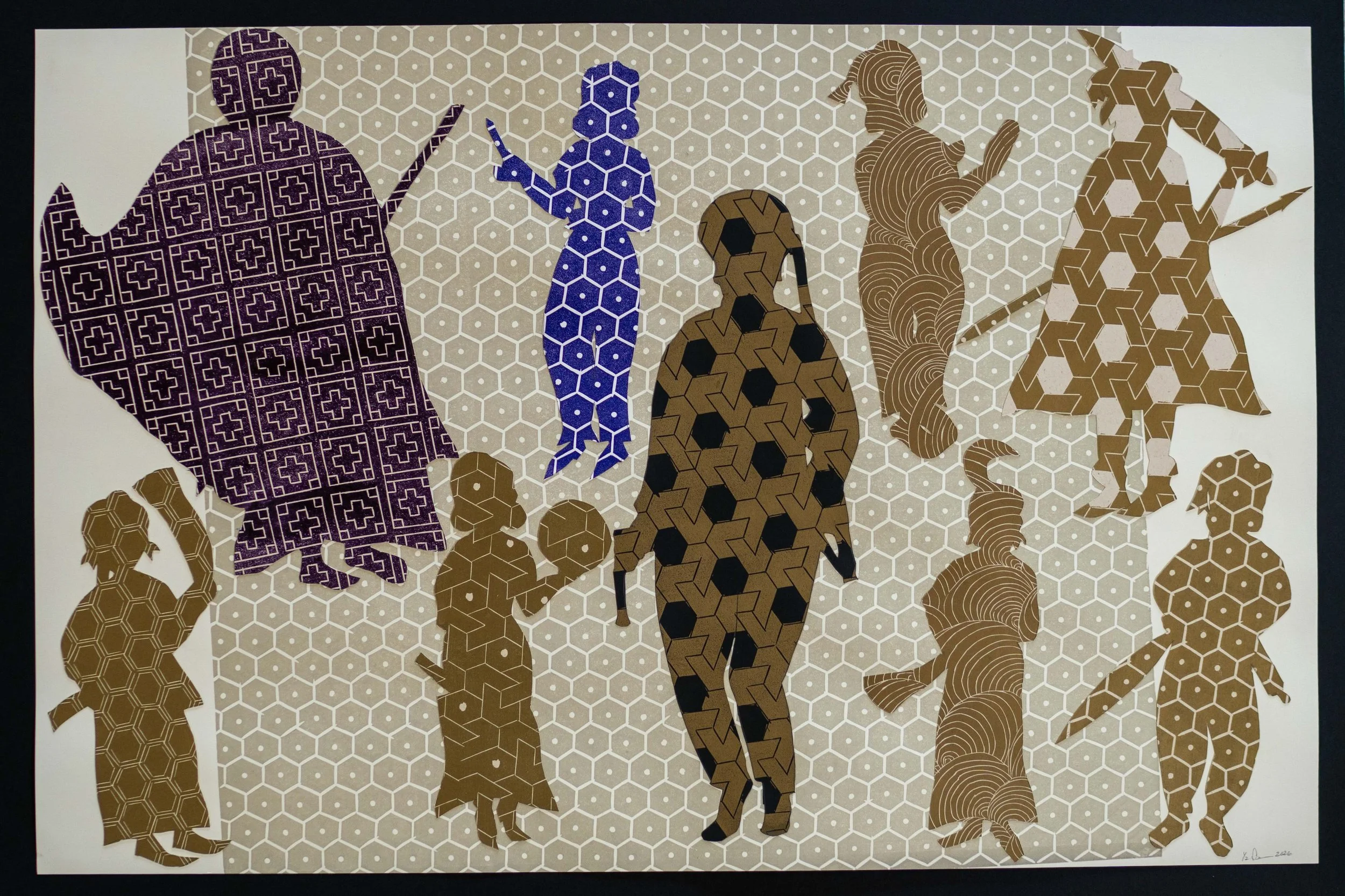
Multitudes 1, 23 x 35 inches, Material: Lino cuts on letter press and French press prints on wasli paper and/or Rives Black and White papers, and hand marbled papers $1500
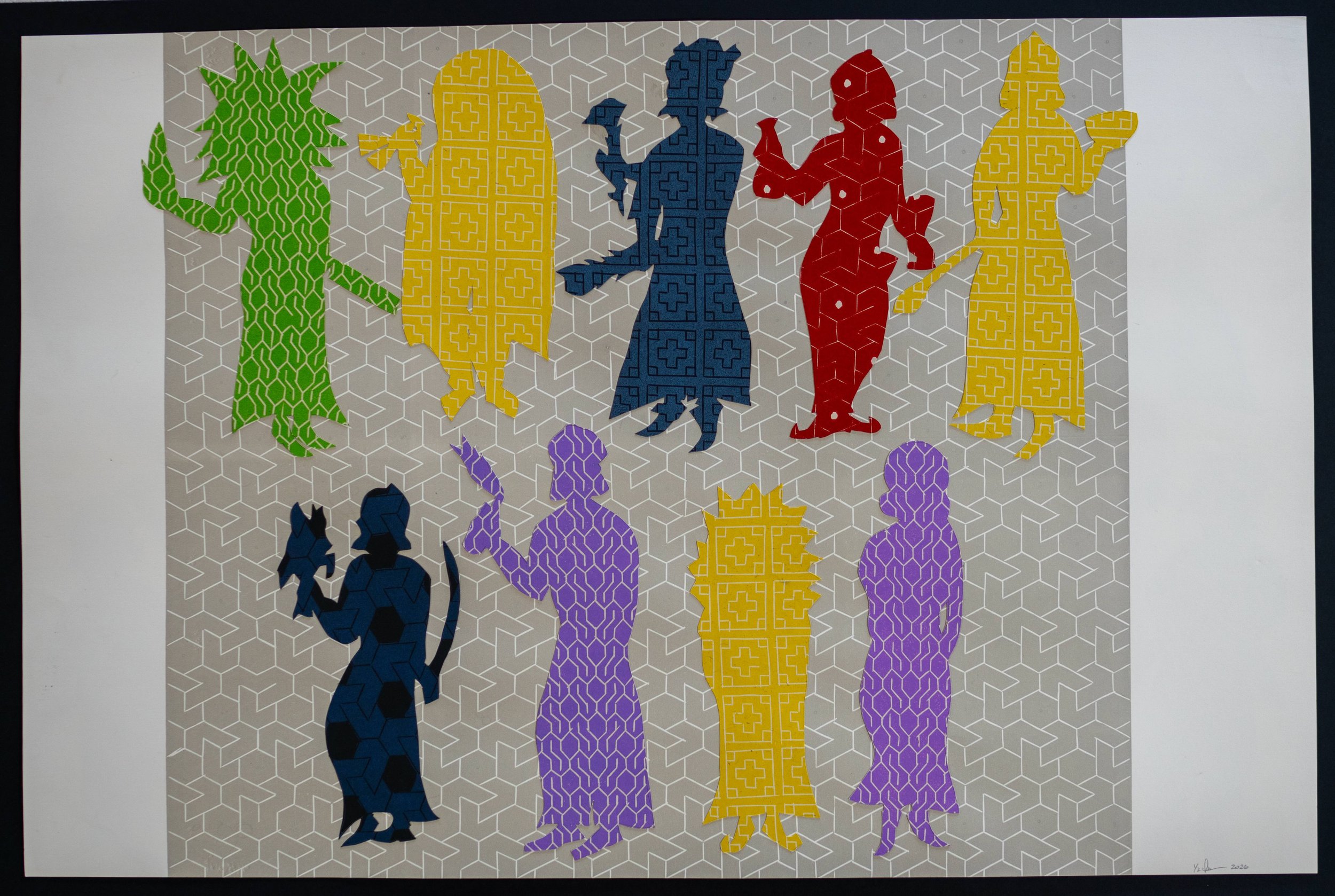
Multitudes 2, 23 x 35 inches, Material: Lino cuts on letter press and French press prints on wasli paper and/or Rives Black and White papers, and hand marbled papers $1500
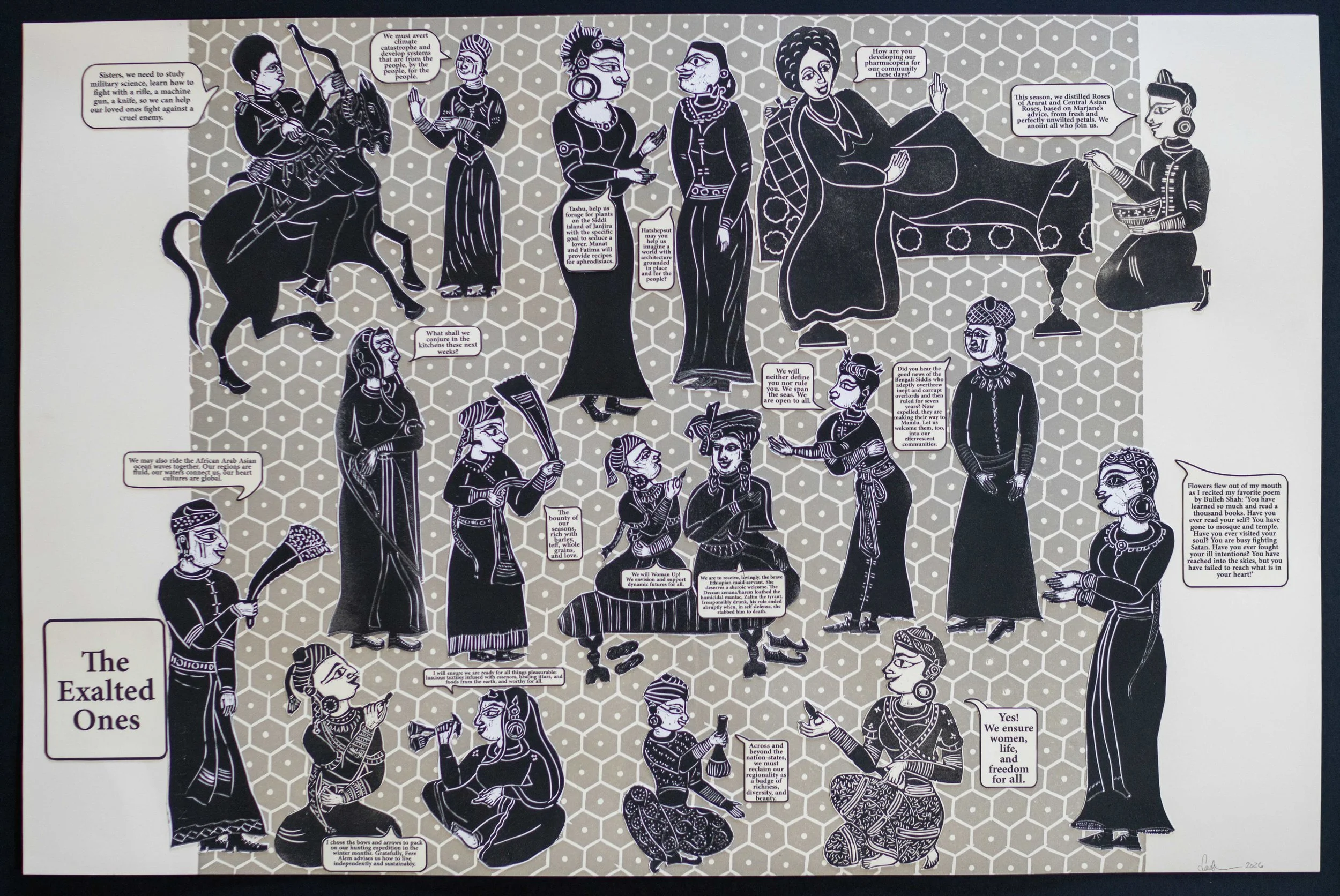
The Exalted Ones In pre-Islamic times certain goddesses with power and prestige were referred to as the exalted ones. Here their possible stories, histories, and powers are unerased. A creative graphic, across time and space, of conversations muted, to re-member denied pasts. (23 x 35 inches, Material: Lino cuts on letter press and large press prints on wasli paper and/or Rives Black and White papers 2026) $1500